Contents
5 November 2026 Proposed structure under US GAAP
1 NetWrap and OSTTRA comparison
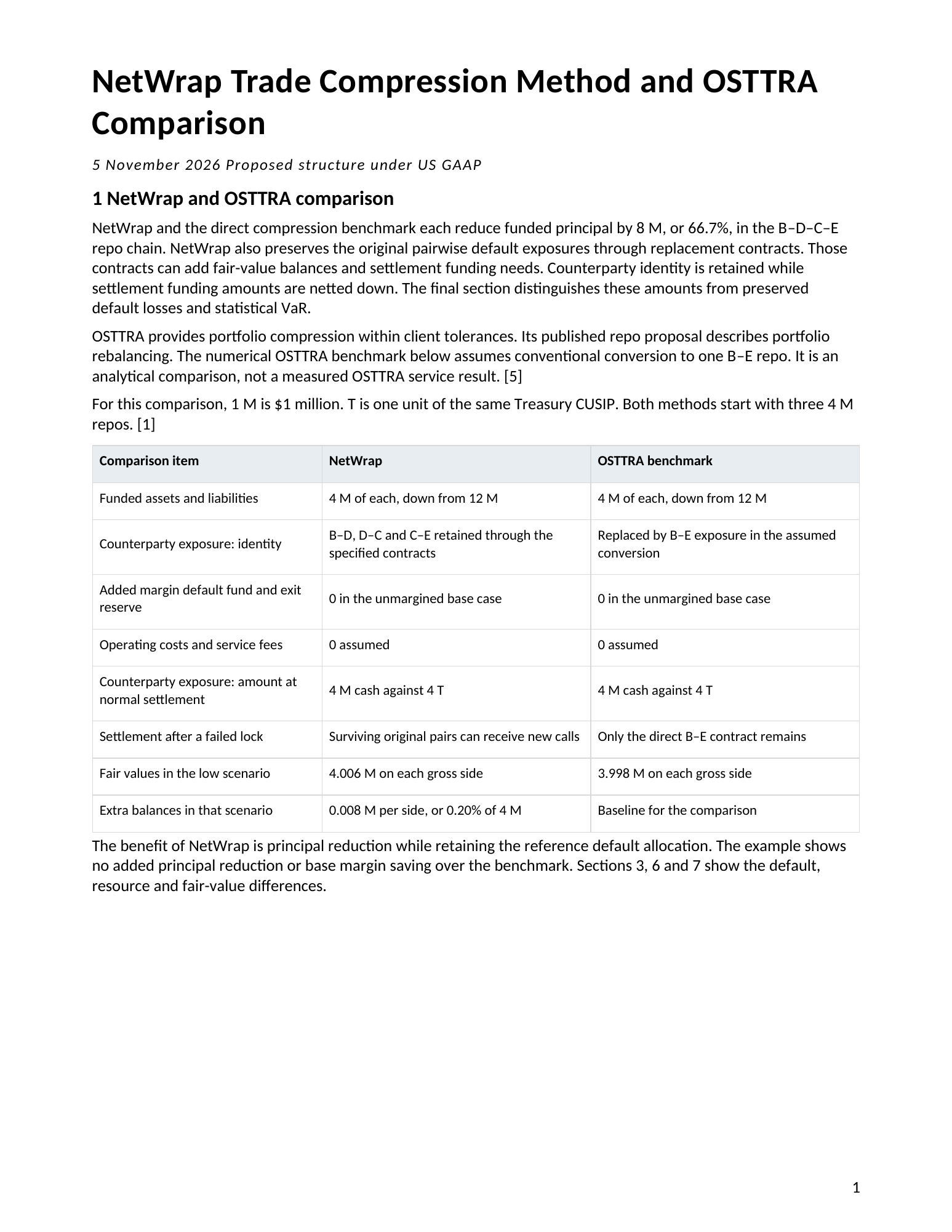
NetWrap and the direct compression benchmark each reduce funded principal by 8 M, or 66.7%, in the B–D–C–E repo chain. NetWrap also preserves the original pairwise default exposures through replacement contracts. Those contracts can add fair-value balances and settlement funding needs. Counterparty identity is retained while settlement funding amounts are netted down. The final section distinguishes these amounts from preserved default losses and statistical VaR.
OSTTRA provides portfolio compression within client tolerances. Its published repo proposal describes portfolio rebalancing. The numerical OSTTRA benchmark below assumes conventional conversion to one B–E repo. It is an analytical comparison, not a measured OSTTRA service result. [5]
For this comparison, 1 M is $1 million. T is one unit of the same Treasury CUSIP. Both methods start with three 4 M repos. [1]
Comparison item | NetWrap | OSTTRA benchmark |
|---|---|---|
Funded assets and liabilities | 4 M of each, down from 12 M | 4 M of each, down from 12 M |
Counterparty exposure: identity | B–D, D–C and C–E retained through the specified contracts | Replaced by B–E exposure in the assumed conversion |
Added margin default fund and exit reserve | 0 in the unmargined base case | 0 in the unmargined base case |
Operating costs and service fees | 0 assumed | 0 assumed |
Counterparty exposure: amount at normal settlement | 4 M cash against 4 T | 4 M cash against 4 T |
Settlement after a failed lock | Surviving original pairs can receive new calls | Only the direct B–E contract remains |
Fair values in the low scenario | 4.006 M on each gross side | 3.998 M on each gross side |
Extra balances in that scenario | 0.008 M per side, or 0.20% of 4 M | Baseline for the comparison |
The benefit of NetWrap is principal reduction while retaining the reference default allocation. The example shows no added principal reduction or base margin saving over the benchmark. Sections 3, 6 and 7 show the default, resource and fair-value differences.
2 Funded principal comparison
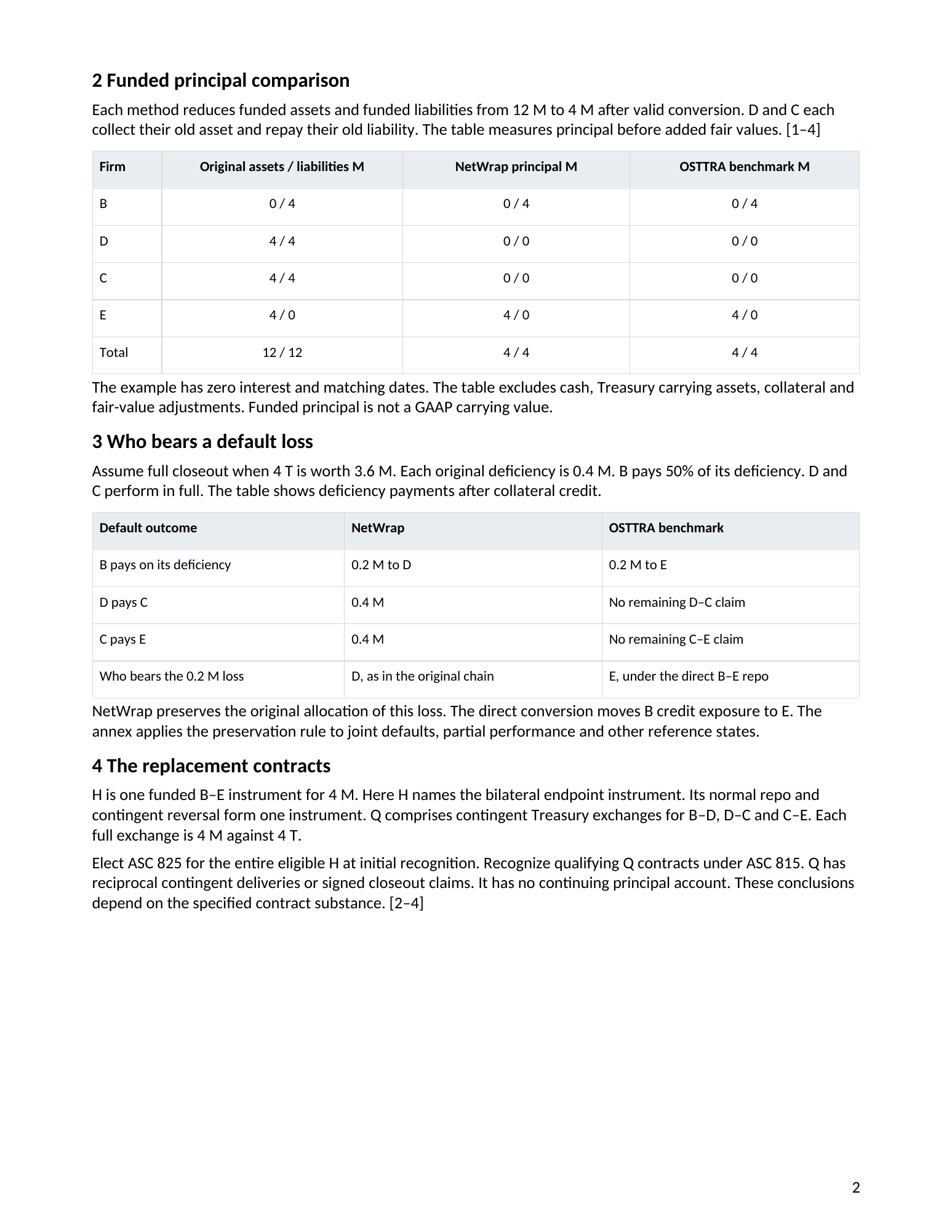
Each method reduces funded assets and funded liabilities from 12 M to 4 M after valid conversion. D and C each collect their old asset and repay their old liability. The table measures principal before added fair values. [1–4]
Firm | Original assets / liabilities M | NetWrap principal M | OSTTRA benchmark M |
|---|---|---|---|
B | 0 / 4 | 0 / 4 | 0 / 4 |
D | 4 / 4 | 0 / 0 | 0 / 0 |
C | 4 / 4 | 0 / 0 | 0 / 0 |
E | 4 / 0 | 4 / 0 | 4 / 0 |
Total | 12 / 12 | 4 / 4 | 4 / 4 |
The example has zero interest and matching dates. The table excludes cash, Treasury carrying assets, collateral and fair-value adjustments. Funded principal is not a GAAP carrying value.
3 Who bears a default loss
Assume full closeout when 4 T is worth 3.6 M. Each original deficiency is 0.4 M. B pays 50% of its deficiency. D and C perform in full. The table shows deficiency payments after collateral credit.
Default outcome | NetWrap | OSTTRA benchmark |
|---|---|---|
B pays on its deficiency | 0.2 M to D | 0.2 M to E |
D pays C | 0.4 M | No remaining D–C claim |
C pays E | 0.4 M | No remaining C–E claim |
Who bears the 0.2 M loss | D, as in the original chain | E, under the direct B–E repo |
NetWrap preserves the original allocation of this loss. The direct conversion moves B credit exposure to E. The annex applies the preservation rule to joint defaults, partial performance and other reference states.
4 The replacement contracts
H is one funded B–E instrument for 4 M. Here H names the bilateral endpoint instrument. Its normal repo and contingent reversal form one instrument. Q comprises contingent Treasury exchanges for B–D, D–C and C–E. Each full exchange is 4 M against 4 T.
Elect ASC 825 for the entire eligible H at initial recognition. Recognize qualifying Q contracts under ASC 815. Q has reciprocal contingent deliveries or signed closeout claims. It has no continuing principal account. These conclusions depend on the specified contract substance. [2–4]
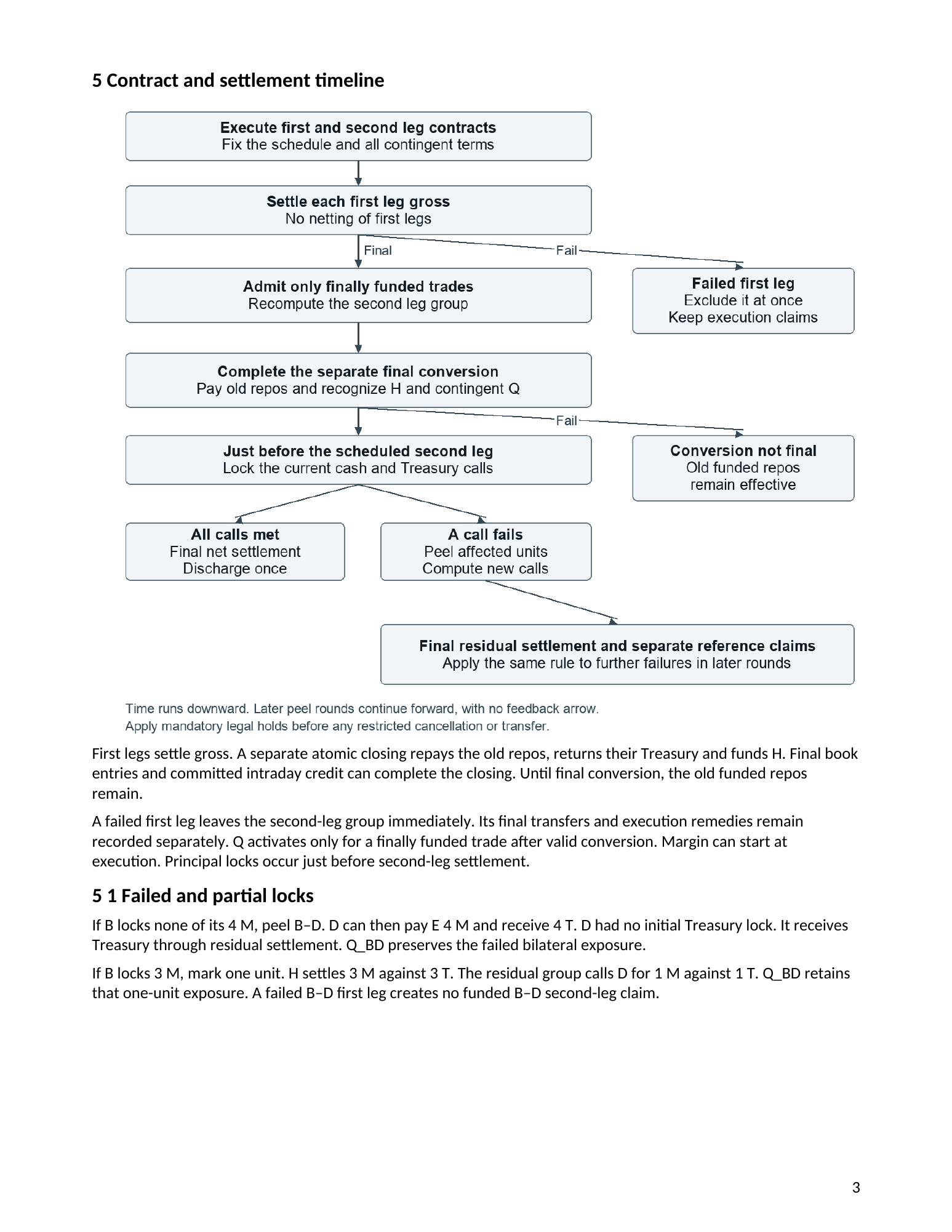
5 Contract and settlement timeline
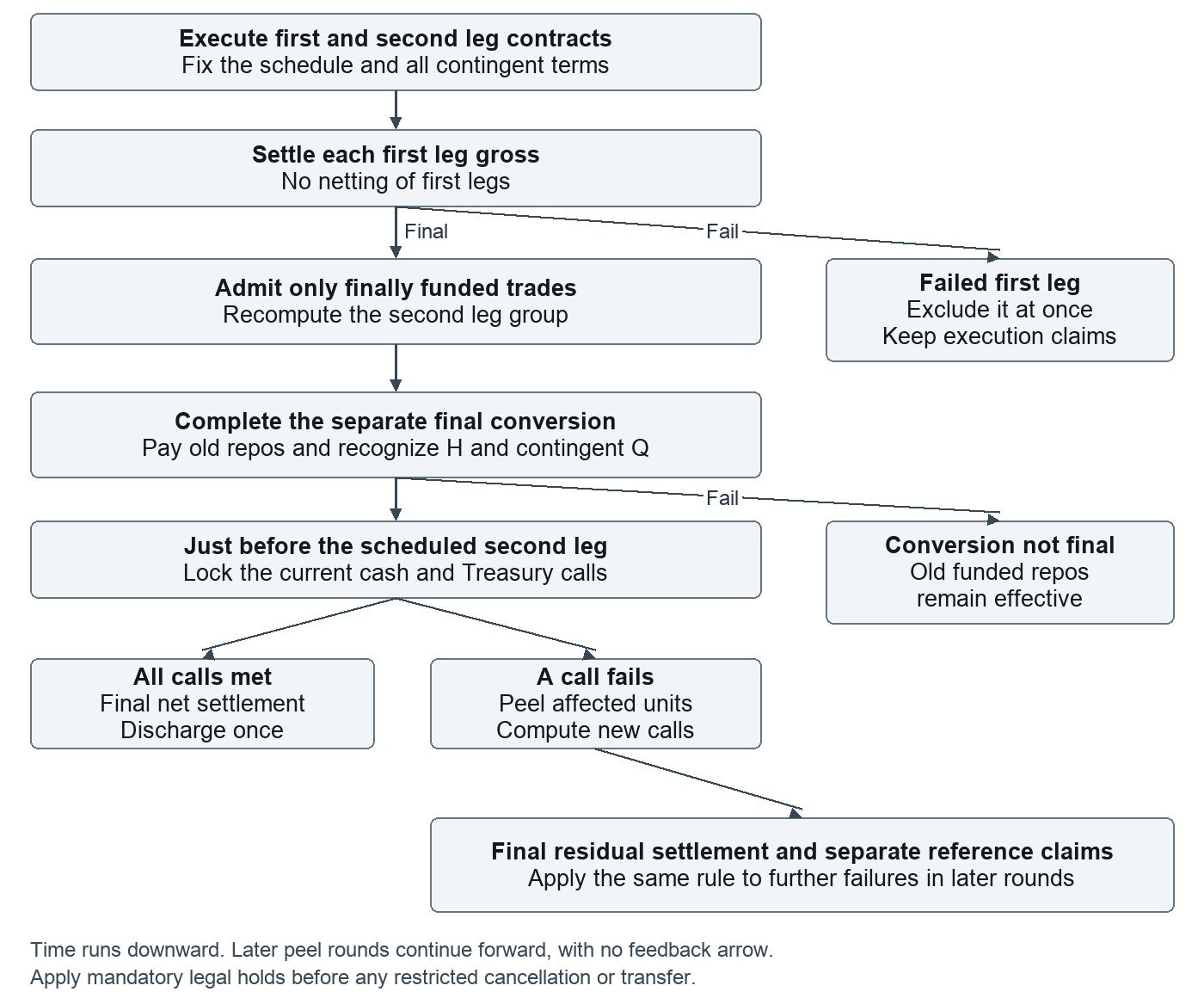
First legs settle gross. A separate atomic closing repays the old repos, returns their Treasury and funds H. Final book entries and committed intraday credit can complete the closing. Until final conversion, the old funded repos remain.
A failed first leg leaves the second-leg group immediately. Its final transfers and execution remedies remain recorded separately. Q activates only for a finally funded trade after valid conversion. Margin can start at execution. Principal locks occur just before second-leg settlement.
5 1 Failed and partial locks
If B locks none of its 4 M, peel B–D. D can then pay E 4 M and receive 4 T. D had no initial Treasury lock. It receives Treasury through residual settlement. Q_BD preserves the failed bilateral exposure.
If B locks 3 M, mark one unit. H settles 3 M against 3 T. The residual group calls D for 1 M against 1 T. Q_BD retains that one-unit exposure. A failed B–D first leg creates no funded B–D second-leg claim.
6 Margin reserves and annual cost comparison
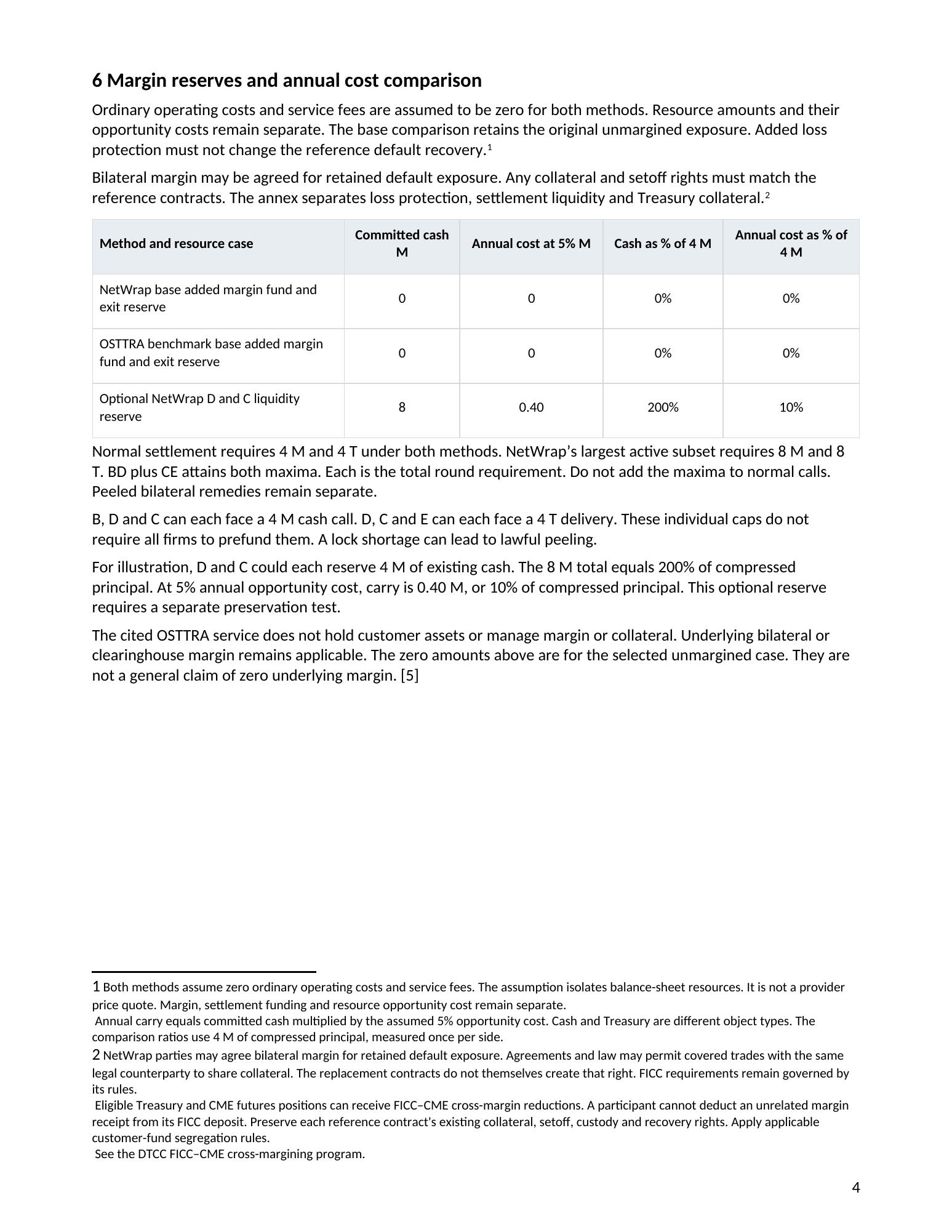
Ordinary operating costs and service fees are assumed to be zero for both methods. Resource amounts and their opportunity costs remain separate. The base comparison retains the original unmargined exposure. Added loss protection must not change the reference default recovery.1
Bilateral margin may be agreed for retained default exposure. Any collateral and setoff rights must match the reference contracts. The annex separates loss protection, settlement liquidity and Treasury collateral.2
Method and resource case | Committed cash M | Annual cost at 5% M | Cash as % of 4 M | Annual cost as % of 4 M |
|---|---|---|---|---|
NetWrap base added margin fund and exit reserve | 0 | 0 | 0% | 0% |
OSTTRA benchmark base added margin fund and exit reserve | 0 | 0 | 0% | 0% |
Optional NetWrap D and C liquidity reserve | 8 | 0.40 | 200% | 10% |
Normal settlement requires 4 M and 4 T under both methods. NetWrap’s largest active subset requires 8 M and 8 T. BD plus CE attains both maxima. Each is the total round requirement. Do not add the maxima to normal calls. Peeled bilateral remedies remain separate.
B, D and C can each face a 4 M cash call. D, C and E can each face a 4 T delivery. These individual caps do not require all firms to prefund them. A lock shortage can lead to lawful peeling.
For illustration, D and C could each reserve 4 M of existing cash. The 8 M total equals 200% of compressed principal. At 5% annual opportunity cost, carry is 0.40 M, or 10% of compressed principal. This optional reserve requires a separate preservation test.
The cited OSTTRA service does not hold customer assets or manage margin or collateral. Underlying bilateral or clearinghouse margin remains applicable. The zero amounts above are for the selected unmargined case. They are not a general claim of zero underlying margin. [5]
7 Fair value comparison
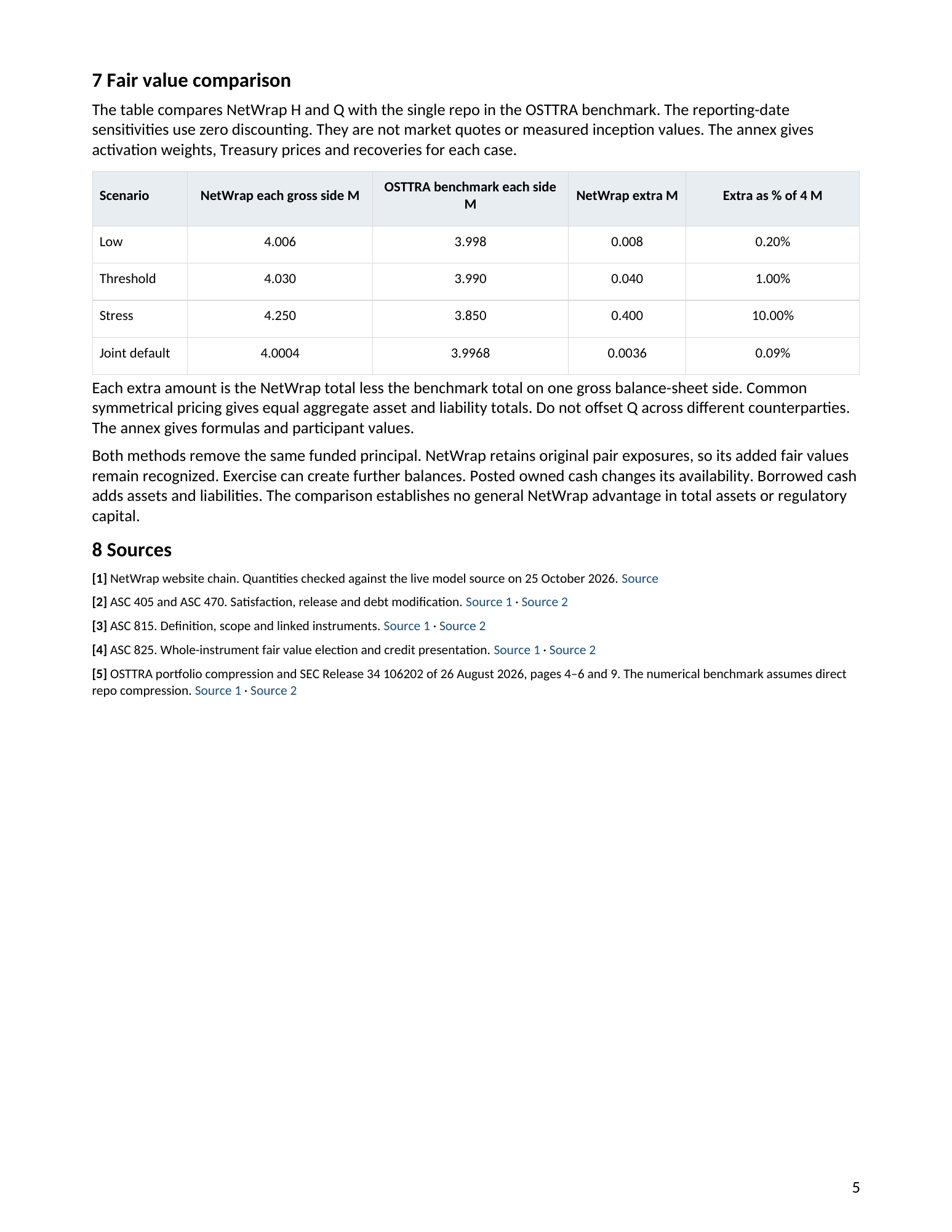
The table compares NetWrap H and Q with the single repo in the OSTTRA benchmark. The reporting-date sensitivities use zero discounting. They are not market quotes or measured inception values. The annex gives activation weights, Treasury prices and recoveries for each case.
Scenario | NetWrap each gross side M | OSTTRA benchmark each side M | NetWrap extra M | Extra as % of 4 M |
|---|---|---|---|---|
Low | 4.006 | 3.998 | 0.008 | 0.20% |
Threshold | 4.030 | 3.990 | 0.040 | 1.00% |
Stress | 4.250 | 3.850 | 0.400 | 10.00% |
Joint default | 4.0004 | 3.9968 | 0.0036 | 0.09% |
Each extra amount is the NetWrap total less the benchmark total on one gross balance-sheet side. Common symmetrical pricing gives equal aggregate asset and liability totals. Do not offset Q across different counterparties. The annex gives formulas and participant values.
Both methods remove the same funded principal. NetWrap retains original pair exposures, so its added fair values remain recognized. Exercise can create further balances. Posted owned cash changes its availability. Borrowed cash adds assets and liabilities. The comparison establishes no general NetWrap advantage in total assets or regulatory capital.
8 Sources
[1] NetWrap website chain. Quantities checked against the live model source on 25 October 2026. Source
[2] ASC 405 and ASC 470. Satisfaction, release and debt modification. Source 1 · Source 2
[3] ASC 815. Definition, scope and linked instruments. Source 1 · Source 2
[4] ASC 825. Whole-instrument fair value election and credit presentation. Source 1 · Source 2
[5] OSTTRA portfolio compression and SEC Release 34 106202 of 26 August 2026, pages 4–6 and 9. The numerical benchmark assumes direct repo compression. Source 1 · Source 2
Exposure identity and amount
Counterparty exposure identity. Identity means the original pair to which an unpaid obligation or default loss belongs. NetWrap retains that pair and its specified reference recovery rights. A direct settlement route does not itself replace the party bearing the loss.
Counterparty exposure amount. Amount requires a stated measure. For settlement, it is the cash or securities that each participant must lock for the active group. For credit loss, it is the unrecovered reference claim after closeout, collateral and estate recoveries. These are different amounts. The website phrase “original counterparty exposure preserved and reduced” refers to identity retained and settlement funding netted down.
Net funding and the shortfall bound. For participant i and object k in a fixed active group, let G be gross outgoing obligations and A be incoming obligations. The net lock requirement is R = max(G - A, 0), so 0 <= R <= G. With usable funding F >= 0, the lock shortfall is max(R - F, 0) <= max(G - F, 0). Netting therefore weakly reduces the maximum shortfall on that round’s funding call. A participant without offsetting inflows may have no reduction. Cash and securities remain separate objects.
Recalculation after a failure. A peel changes the active group and can raise a survivor’s call relative to the previous net call. Apply the bound to that new group. Peeled obligations remain separately enforceable; their removal is not an additional saving or a reduction in the reference creditor’s loss.
Value at risk. Statistical value at risk (VaR) is a loss quantile for a stated horizon and probability model. A lower funding requirement alone does not establish lower default-loss VaR. If each participant has the same loss in every reference state, with the same state probabilities, its default-loss VaR is unchanged. Reduced liquidity pressure can affect default probabilities or funding costs in a broader model, but those effects require calibration. No strict VaR reduction for every participant is established here.
Amounts in the compression example. Normal settlement uses 4 M and 4 T instead of 12 M and 12 T gross, a 66.7% reduction in each object. Across active subsets, the separate maxima are 8 M and 8 T. In the stated B default example, D still bears the same 0.2 M reference loss. The smaller normal lock amount does not reduce that preserved loss.
Risk reduction and margin. Less cash and fewer securities needed for settlement can ease liquidity pressure while original pairs retain default responsibility. The zero added margin, default fund and exit reserve remain assumptions of the unmargined comparison; they are not a waiver of agreed bilateral margin or an existing clearinghouse’s requirements.
Footnotes
Both methods assume zero ordinary operating costs and service fees. The assumption isolates balance-sheet resources. It is not a provider price quote. Margin, settlement funding and resource opportunity cost remain separate.
Annual carry equals committed cash multiplied by the assumed 5% opportunity cost. Cash and Treasury are different object types. The comparison ratios use 4 M of compressed principal, measured once per side.
↩NetWrap parties may agree bilateral margin for retained default exposure. Agreements and law may permit covered trades with the same legal counterparty to share collateral. The replacement contracts do not themselves create that right. FICC requirements remain governed by its rules.
Eligible Treasury and CME futures positions can receive FICC–CME cross-margin reductions. A participant cannot deduct an unrelated margin receipt from its FICC deposit. Preserve each reference contract's existing collateral, setoff, custody and recovery rights. Apply applicable customer-fund segregation rules.
See the DTCC FICC–CME cross-margining program.
↩