

Contents
- 1 Scope and conclusion
- 1 1 Execute all contingent terms at inception
- 1 2 Complete a separate final conversion
- 1 3 Preserve substance
- 2 Replacement contract terms
- 2 1 Funded endpoint instrument H
- 2 2 Unfunded original pair exchanges Q
- 2 3 ASC 815 classification
- 2 4 ASC 825 election for H
- 2 5 Exact replacement rule for each unit
- 2 6 Operative Treasury allocation
- 3 First leg failures and conversion
- 3 1 B fails the first leg
- 3 2 B fails the second leg lock
- 3 3 Treasury failure
- 4 Joint default states
- 4 1 State identity
- 5 Shared legal basis and NetWrap terms
- 5 1 Apply the same baseline
- 5 2 Qualify the new Q contracts
- 5 3 Keep H inseparable
- 5 4 Separate settlement and peeled claims
- 5 5 Record a legally unavailable lock
- 5 6 Treat avoidance consistently
- 6 Property margin and avoidance
- 6 1 Keep property rights
- 6 2 Add margin without changing reference recoveries
- 6 3 Avoidance and obligation incurrence
- 6 4 Reference valuation and excess
- 7 Accounting implementation and limits
- 7 1 Extinguishment and debt modification
- 7 2 Recognition after a valid conversion
- 7 3 Equality with the baseline
- 7 4 Implementation record
- 8 Quantified resources and fair values
- 8 1 Common cost and margin assumptions
- 8 2 Exact settlement capacity
- 8 3 Fair value model
- 8 4 Participant and default state balances
- 9 Sources
- Exposure identity and amount
5 November 2026 Proposed structure under US GAAP
1 Scope and conclusion
This annex defines the NetWrap method for the B–D–C–E website chain. Each of its three repos has 4 M and 4 T. It supports the companion method paper. The target is removal of 8 M of intermediary financing assets and liabilities. Recognize the remaining funded instrument and all other required balances. [1] For this comparison, 1 M is $1 million. Counterparty identity is retained while settlement funding amounts are netted down. The final section distinguishes these amounts from preserved default losses and statistical VaR.
On the selected terms, D and C collect their old loans and repay their borrowings. The 12 M funded principal becomes one 4 M endpoint instrument plus Q fair values. This is the same 8 M principal reduction as direct compression. It is an accounting inference from the specified substance, not an issued NetWrap ruling. [2–5]
1 1 Execute all contingent terms at inception
The standing agreement shall bind each party at original execution. It shall specify both legs, each reference pair, and the conversion terms. It shall fix the original CUSIP, amount, interest, dates, custody rights, priority, defenses and closeout elections. It shall also fix the peel rule and residual call rule. No later default shall require a new agreement.
Each Q shall depend on a finally funded trade and a valid conversion. A failed first leg shall leave the second-leg group at once. The execution record shall retain breach damages and rights from any final partial transfer. Exclusion shall not reverse a transfer or create funded repo principal.
1 2 Complete a separate final conversion
After successful gross first legs, repay B to D, D to C, and C to E, each 4 M. Return Treasury E to C, C to D, and D to B, each 4 T. Then fund the new B–E instrument: E pays B 4 M and B delivers E 4 T. Final book entries may complete these transfers. The settlement system shall prove payment, discharge and available intraday credit.
Use an atomic closing with a defined legal finality point. Each old creditor shall accept payment in full satisfaction. Each old debtor shall be released from the funded principal. The old repos shall remain effective until the entire conversion becomes final. A failed closing shall leave them in force. This is continuation, not revival.
Where atomic finality is not available, do not convert. Preserve separately any irreversible partial closing payment and its restitution or credit rights. The system shall not assume that an instruction can undo a final transfer.
1 3 Preserve substance
Each old intermediary shall collect its loan and repay its borrowing. Neither the old receivable nor the repayment proceeds shall be contributed or assigned as Q consideration. Q shall have no full principal prepayment, loan account or continued interest balance. Include both cash and noncash consideration in the initial-investment analysis. [2–5]
2 Replacement contract terms
2 1 Funded endpoint instrument H
H shall be one B–E instrument with funded notional 4 M. Here H names the bilateral endpoint instrument. Normal settlement requires B to pay 4 M against E delivering 4 T. H shall contain the specified contingent reversal. A reference event that breaks the normal chain shall cancel the matched normal and reverse duties to the specified extent. The Q schedule shall then supply the reference exchanges.
Neither H component may be assigned, collected or terminated alone. Use the same entities, legal capacity, currency, CUSIP, dates and valuation rules. Calculate one signed bilateral amount. Do not create separate artificial B–E default claims. H remains payable in the normal state. Its relevant default components cancel only under their stated matched rule.
2 2 Unfunded original pair exchanges Q
Q_BD, Q_DC and Q_CE shall each be a binding event-contingent Treasury exchange. Each uses 4 M against 4 T. Before activation, no party has an unconditional right or duty to acquire the underlying Treasury. A reference lock failure, permitted closeout or chain break activates the specified exchange branch.
Q shall have no principal advance, full prepayment or stand-alone repayment right. Its cash delivery duty shall have the reciprocal Treasury duty. A permitted closeout replaces both with the signed reference amount. Separately refundable collateral shall not serve as disguised purchase consideration or prepaid Treasury delivery.
The entire package shall expire only after final discharge of its relevant duties. A surviving pair shall retain its original maturity and elections. A partial peel shall not cancel an unpaid pair. No Q provision shall revive an old repo.
2 3 ASC 815 classification
The Treasury price and stated financial event are underlyings. The quantity is a notional amount. There is no new initial funding for Q. Limit admission to a Treasury CUSIP and quantity that are readily convertible to cash. Physical delivery can then meet the net-settlement characteristic. Recognize qualifying Q instruments at fair value. [3]
These are genuine contingent exchanges. They are not unconditional purchases with a new label. The conditional purchase branch addresses the regular-way purchase issue. If the executed rights instead create an unconditional security acquisition at inception, apply the required trade-date accounting. Full prepayment would also undermine the proposed unfunded derivative analysis. [3]
After conversion, activation shall depend on the price or performance of identified financial obligations in the replacement package. An operator outage alone shall not activate Q unless financial performance fails. The conversion contingency is then resolved. Apply the relevant ASC 815 scope rules before and after adoption of ASU 2025-07. [16]
2 4 ASC 825 election for H
Each endpoint shall elect the fair value option for its entire eligible H at initial recognition. H shall be a fixed-term financial instrument between unrelated parties. It shall not be an excluded deposit, equity, lease, benefit or consolidated-investee interest. Document the irrevocable election. This avoids dependence on a finding that an embedded feature requires separation. [4]
H carries its whole-instrument fair value, not necessarily 4 M. Apply the required instrument-specific credit presentation to the issuer. Recognize Q separately as required. Zero funding does not mean zero fair value. Allocate package consideration and recognize required initial values and gains or losses.
2 5 Exact replacement rule for each unit
Divide the 4 T chain into labelled Treasury units. Each unit has 1 M against 1 T on each original edge. The schedule shall use the same deterministic unit choice and peel order as the reference protocol. Mark a unit only at its first lawful event that breaks normal endpoint settlement. A unit cannot be marked after its final discharge.
H_live is remaining H quantity. Q_e is remaining quantity for pair e. m is cumulative marked quantity. It never decreases. h is final normal H discharge. d_e is that Q pair’s final discharge. Do not mark a normally discharged unit. Final Q discharge does not restore H. Separate object credits apply below.
For each marked unit, cancel 1 M against 1 T of H. Activate the same unit on Q_BD, Q_DC and Q_CE. These acts shall take effect together when lawful. The three original-pair exchanges then replace the endpoint exchange for that unit. Unmarked units remain under H. No old funded debt returns.
A peel removes only the failed reference edge from the active settlement set. The other activated Q edges can settle through the residual group. A permitted early closeout terminates only the eligible Q pair. Other activated pairs retain their original dates and elections. Marking all four units does not itself close every Q.
For example, B locks 3 M and fails 1 M. Mark one unit. H settles 3 M against 3 T normally. The one-unit Q_DC and Q_CE group calls D for 1 M and delivers D 1 T. Q_BD retains the one-unit bilateral exchange.
If D also fails, its edge peels and C receives the next lawful call. Apply the same rule to Treasury failures and overlapping failures.
Track each Q pair separately. Its remaining quantity equals activated quantity less its own final discharges. Payment on DC shall not discharge an unpaid BD claim. Keep separate final cash and Treasury credits by unit, payer and recipient.
Admit settlement units only with legally atomic paired delivery and net discharge. If a transfer nevertheless becomes final alone, freeze that unit. Preserve its property and restitution rights. Allocate its cash or Treasury credit under the inception reference schedule before any Q activation. Do not cancel final cash or activate a full uncredited duty.
2 6 Operative Treasury allocation
E remains the legal holder of the original 4 T, subject to the agreed custody and reuse terms. For each unmarked unit, E owes the return to B under H. For each marked unit, E owes the return to C under Q_CE. C owes D under Q_DC.
D owes B under Q_BD. The corresponding cash duties run in reverse. This substitution creates no extra Treasury.
The account control terms shall grant these contingent return rights at inception. At a lawful activation, the designated Q return duties replace H’s duty for that unit. Final residual delivery discharges the intervening duties once. If return is replaced by closeout, apply the original ownership, realization, excess and deficiency rules. Do not create a new postpetition lien.
At full lawful closeout and price 0.90 M, E retains or realizes Treasury value 3.60 M. E also has the 0.40 M CE deficiency claim. Do not replace H’s 4 M asset with only a 0.40 M claim and omit the Treasury value. Apply the corresponding credits upstream once.
Accounting ownership can differ from legal title. Assess the Treasury under ASC 860 at conversion and again at activation or exercise. The whole-H fair value election does not decide that issue. A Treasury asset, return duty or new funded claim may become recognized. The principal comparison excludes those separate balances. [6]
3 First leg failures and conversion
Each first leg settles gross. The following table covers all eight funded subsets. BD means the B–D repo, and likewise for DC and CE. Compress only a connected funded segment. Do not bridge a failed edge. Its separate execution claims remain.
Finally funded repos | Eligible funded structure | Total principal M |
|---|---|---|
None | No funded second-leg group | 0 |
BD only | B–D financing | 4 |
DC only | D–C financing | 4 |
CE only | C–E financing | 4 |
BD and DC | B–C segment | 4 |
DC and CE | D–E segment | 4 |
BD and CE | Two separate financings | 8 |
BD and DC and CE | B–E segment | 4 |
The principal column assumes valid conversion of each multi-edge segment. A single edge needs no compression. Before final conversion, the original funded principal remains. Two funded adjacent repos have 8 M gross principal until that conversion.
3 1 B fails the first leg
If B–D does not fund, exclude it immediately. If DC and CE fund, their normal second leg is D paying E 4 M against E delivering D 4 T. Q_BD shall have no funded exchange exposure. Any B–D execution damages remain in the separate record.
3 2 B fails the second leg lock
All three first legs and conversion have completed. B supplies none of its 4 M lock. Peel the full BD exchange. Cancel the matched H branch. D now owes the 4 M residual call.
If D locks it, D pays E and E delivers D 4 T. Q_DC and Q_CE settle through the residual group. Q_BD remains as the separate reference exchange.
D had no initial Treasury lock. It receives 4 T through residual settlement. If D also cannot lock, peel DC as the next affected exchange. C can then pay E 4 M and receive 4 T.
If C also fails, no chain payment occurs. CE remains bilateral. Each remaining duty comes from Q, not an old repo.
3 3 Treasury failure
If E cannot deliver, apply the same rule from the Treasury end. Peel CE. The residual B–D–C segment calls for C to deliver 4 T against B paying 4 M. Further failures peel further units. A bilateral failed unit retains its own default remedies. A funding shortage is not itself the amount of a credit loss.
4 Joint default states
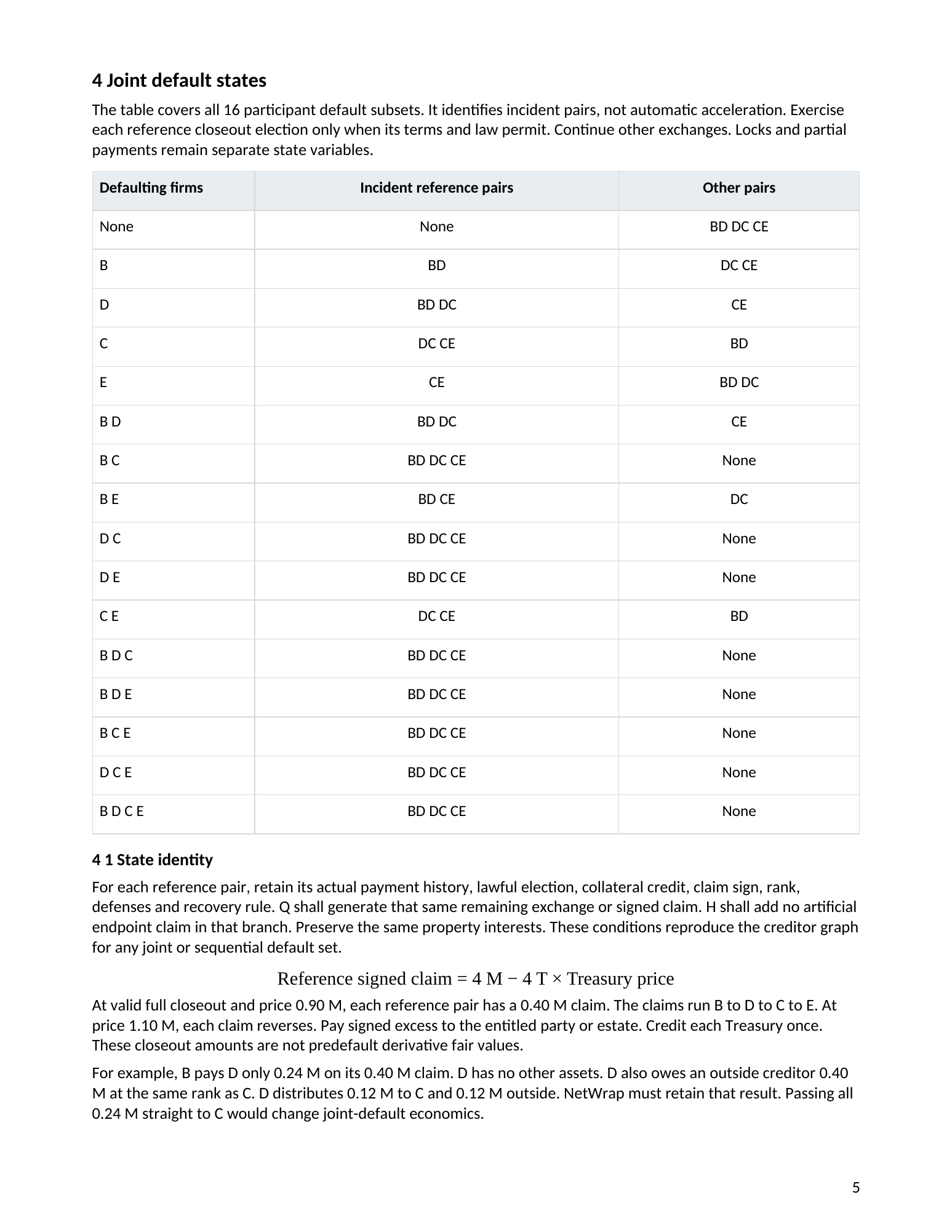
The table covers all 16 participant default subsets. It identifies incident pairs, not automatic acceleration. Exercise each reference closeout election only when its terms and law permit. Continue other exchanges. Locks and partial payments remain separate state variables.
Defaulting firms | Incident reference pairs | Other pairs |
|---|---|---|
None | None | BD DC CE |
B | BD | DC CE |
D | BD DC | CE |
C | DC CE | BD |
E | CE | BD DC |
B D | BD DC | CE |
B C | BD DC CE | None |
B E | BD CE | DC |
D C | BD DC CE | None |
D E | BD DC CE | None |
C E | DC CE | BD |
B D C | BD DC CE | None |
B D E | BD DC CE | None |
B C E | BD DC CE | None |
D C E | BD DC CE | None |
B D C E | BD DC CE | None |
4 1 State identity
For each reference pair, retain its actual payment history, lawful election, collateral credit, claim sign, rank, defenses and recovery rule. Q shall generate that same remaining exchange or signed claim. H shall add no artificial endpoint claim in that branch. Preserve the same property interests. These conditions reproduce the creditor graph for any joint or sequential default set.
At valid full closeout and price 0.90 M, each reference pair has a 0.40 M claim. The claims run B to D to C to E. At price 1.10 M, each claim reverses. Pay signed excess to the entitled party or estate. Credit each Treasury once. These closeout amounts are not predefault derivative fair values.
For example, B pays D only 0.24 M on its 0.40 M claim. D has no other assets. D also owes an outside creditor 0.40 M at the same rank as C. D distributes 0.12 M to C and 0.12 M outside. NetWrap must retain that result. Passing all 0.24 M straight to C would change joint-default economics.
5 Shared legal basis and NetWrap terms
5 1 Apply the same baseline
Both methods require authority, effective payment or release, settlement finality, custody rights and applicable insolvency law. Both remain subject to mandatory stays and applicable avoidance rules. Apply these assumptions equally. They are implementation requirements, not reasons to prefer one method. OSTTRA is a compression service. It does not supply FICC’s principal guarantee. [2, 9–10, 12, 15]
5 2 Qualify the new Q contracts
Q shall be a substantive contingent Treasury exchange under the securities-contract and debt option or forward definitions, as applicable. Establish each participant’s eligible status at admission. Use section 560 for qualifying swap participants and section 555 only for its eligible parties. Original repo status does not alone establish Q status. These terms select the legal route for the new product. [7]
5 3 Keep H inseparable
H shall remain one instrument with one bilateral payment calculation. Its normal and reverse components shall have identical parties, capacity, currency, CUSIP, timing and valuation. Neither component may be assigned or collected alone. Put the instrument and its credit support in the applicable QFC package. This prevents an artificial B–E claim from surviving a split transfer. [10]
5 4 Separate settlement and peeled claims
Use an eligible organization and members for FDICIA netting under sections 4402 and 4404. Remove a peeled unit from the covered settlement set before that set’s net amount becomes final. Its original-pair Q remains in a separate bilateral set. Do not assert triangular mutuality by contract alone. This preserves the claim that ordinary net-only discharge would otherwise erase. [8]
5 5 Record a legally unavailable lock
Record the deficiency and calculate the required peel. Suspend only an act that applicable law restricts. Resume the lawful step under the same reference rule. A hold does not itself create a new principal loan or revive an old repo. Existing perfected rights use their qualified remedies. New estate transfers require their own legal basis, as they do outside NetWrap. [9]
5 6 Treat avoidance consistently
Document value and authority for each participant at original execution and conversion. The Q duties arise from the signed contingent package, not a new agreement with a failed firm. Test each qualifying transfer and each new obligation under the applicable law. A generic actual-fraud exception applies to both comparison columns. It is not a special prohibition on this structure. [12]
The distinct NetWrap implementation evidence is therefore focused: Q eligibility, H integration, the settlement-set boundary and inception property rights. The contract schedule supplies the required terms. Local opinions establish their operation for the admitted entities and jurisdictions.
6 Property margin and avoidance
6 1 Keep property rights
The custody schedule shall identify each owner, account, beneficial interest, lien, perfection step, reuse right and return duty. Preserve the reference priority and timing. Do not replace a proprietary Treasury right with an unsecured value promise. Use the same custodian and protected accounts where needed to preserve custody-default outcomes. [11]
After the conversion, E holds the 4 T under the endpoint arrangement. The contingent schedule shall state the return or closeout allocation when H cancels. Q shall credit that same Treasury value once. It shall not create extra collateral against a deficiency that already deducts the Treasury value.
The coordinator shall own no participant settlement asset. An independent record and preappointed substitute servicer shall support its failure. A substitute shall not introduce a new guarantee or new credit counterparty. Operator failure alone shall not change reference elections or claim rank.
Custody failure or collateral loss shall use the same reference owner, property claim, priority and loss allocation. A value promise cannot replace missing proprietary rights.
If a custody event makes a lock unavailable, freeze its affected units and verify the shortfall. Apply the reference loss rule before further activation. Record actual collateral credits once.
The substitute servicer shall use the same committed ledger and unresolved instruction status. A replay shall not repeat a final transfer. Operator failure shall add no endpoint claim.
6 2 Add margin without changing reference recoveries
Separate initial margin, variation margin, Treasury repo collateral and settlement liquidity. State ownership, permitted use, funding cost, interest and return for each. Size liquidity for contingent calls on D and C as well as B and E. Principal settlement locks still occur just before maturity.
The benchmark here is the original unmargined exposure. Extra credit margin would change it. Use a separately owned liquidity reserve with protected return, or a fully effective reconciliation. An unsecured promise to repay a default windfall is insufficient. Match funding costs and access timing if they form part of the preserved economics.
Do not treat liquidity collateral as permanent credit-loss protection. The custody and funding terms shall preserve reference default resources and distribution. If permanent credit margin is required, this strict unmargined design cannot also promise unchanged recoveries. The limitation is specific and is shown in the comparison. It is not a general qualification on derecognition.
For example, a reference 0.40 M deficiency with 50 percent recovery pays 0.20 M. Applying new 0.10 M collateral and paying 50 percent on the remaining 0.30 M gives 0.25 M. That violates the benchmark. Refund and restore the original estate claim, or reject that margin design. A refundable liquidity reserve is not permanent credit-loss protection.
Bilateral margin may be agreed for retained default exposure. Preserve each reference collateral and setoff right. Additional credit support requires the same default outcome at each relevant time.1
Margin obligations may be processed across agreed epochs. The wrapper does not create portfolio offsets across unrelated counterparties. Contract terms determine eligible collateral and setoff rights.
Scoped margin records govern application, credit, hold, release and authorized conversion. Each lot portion shall be allocated once. Record actual execution before reusing a lot.
6 3 Avoidance and obligation incurrence
Apply the common avoidance analysis described in section 5.6. The NetWrap-specific record shall show what each firm receives for Q and how the old debt is discharged. Do not rely solely on a bank conduit or on the word derivative. [12]
Bind the contingent Q duties at original execution. Their consideration includes the complete package of rights and releases. Keep the property grants effective before the relevant default. This avoids dependence on new distressed consent. Ordinary avoidance and postpetition-transfer rules still apply. [9, 12]
6 4 Reference valuation and excess
Use each reference closeout election. Apply section 562 where it governs the damages date and valuation. Preserve signed excess and estate entitlements. Do not use a walkaway term to cancel a payment only because its recipient failed. Safe harbors protect qualified remedies. They do not assure future physical performance. [10, 13]
7 Accounting implementation and limits
7 1 Extinguishment and debt modification
ASC 405 requires actual satisfaction with relief, or the relevant legal release. The stronger route here is final cash collection and repayment. Collection of a loan is not a sale of that receivable. Do not use Treasury sale accounting as a substitute for this test. [2]
The selected closing satisfies the old debt and supplies no new financing between its original parties. Q is a reciprocal contingent Treasury exchange. On these facts, apply extinguishment followed by derivative recognition. ASC 470-50 is not a separate 10 percent hurdle merely because the same parties enter Q. It applies if the actual linked arrangement continues or exchanges funded debt. [5]
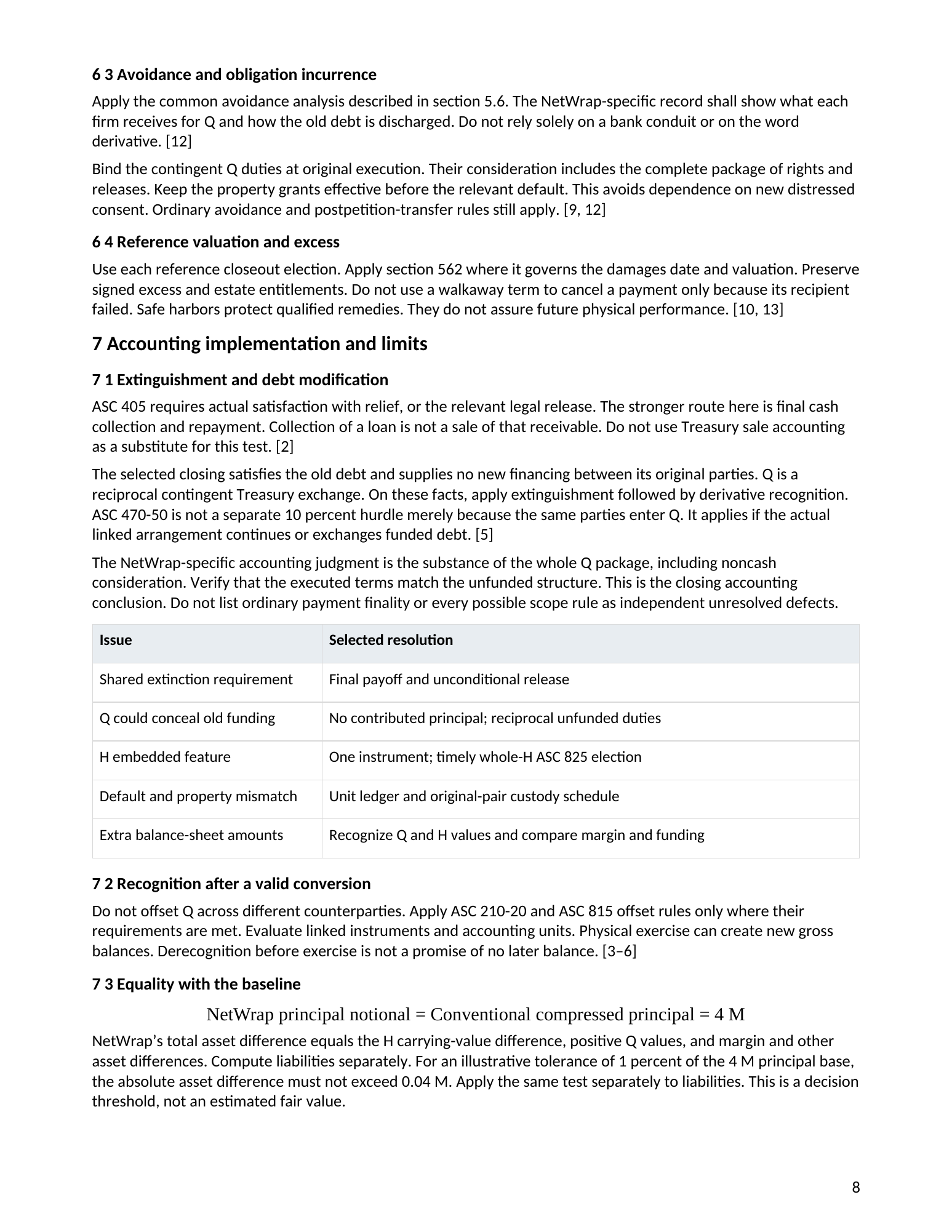
The NetWrap-specific accounting judgment is the substance of the whole Q package, including noncash consideration. Verify that the executed terms match the unfunded structure. This is the closing accounting conclusion. Do not list ordinary payment finality or every possible scope rule as independent unresolved defects.
Issue | Selected resolution |
|---|---|
Shared extinction requirement | Final payoff and unconditional release |
Q could conceal old funding | No contributed principal; reciprocal unfunded duties |
H embedded feature | One instrument; timely whole-H ASC 825 election |
Default and property mismatch | Unit ledger and original-pair custody schedule |
Extra balance-sheet amounts | Recognize Q and H values and compare margin and funding |
7 2 Recognition after a valid conversion
Do not offset Q across different counterparties. Apply ASC 210-20 and ASC 815 offset rules only where their requirements are met. Evaluate linked instruments and accounting units. Physical exercise can create new gross balances. Derecognition before exercise is not a promise of no later balance. [3–6]
7 3 Equality with the baseline
NetWrap’s total asset difference equals the H carrying-value difference, positive Q values, and margin and other asset differences. Compute liabilities separately. For an illustrative tolerance of 1 percent of the 4 M principal base, the absolute asset difference must not exceed 0.04 M. Apply the same test separately to liabilities. This is a decision threshold, not an estimated fair value.
The 8 M reduction is a funded-principal target. Total near equality requires measured extra balances to be small. It cannot hold in every stress state as a matter of contract when the retained original exposures differ from the baseline.
7 4 Implementation record
The specified terms address Q funding, financial triggers, the H election, original-pair activation, property allocation and no-revival accounting. Verify execution against those terms. Obtain the ordinary authority, finality, custody and netting evidence for both comparison columns. Measure the added instruments and margin.
Mandatory insolvency restrictions and avoidance rules apply to conventional transactions too. They are a common comparison assumption, not evidence that NetWrap alone lacks principal derecognition. NetWrap’s additional rights must qualify on their own terms. The remaining package-level substance judgment and measurable balance-sheet additions are identified above.
8 Quantified resources and fair values
8 1 Common cost and margin assumptions
Assume zero ordinary operating costs and service fees for both methods. Do not set resource carry to zero. State stock quantities separately from annual opportunity cost.2
The base example has no added loss absorbing credit margin. It retains the original unmargined recoveries. The service has no separate CCP guarantee or default fund.
TriOptima states that its proposed repo service would not hold customer assets or manage their collateral or margin. Underlying contracts retain their margin requirements. [15]
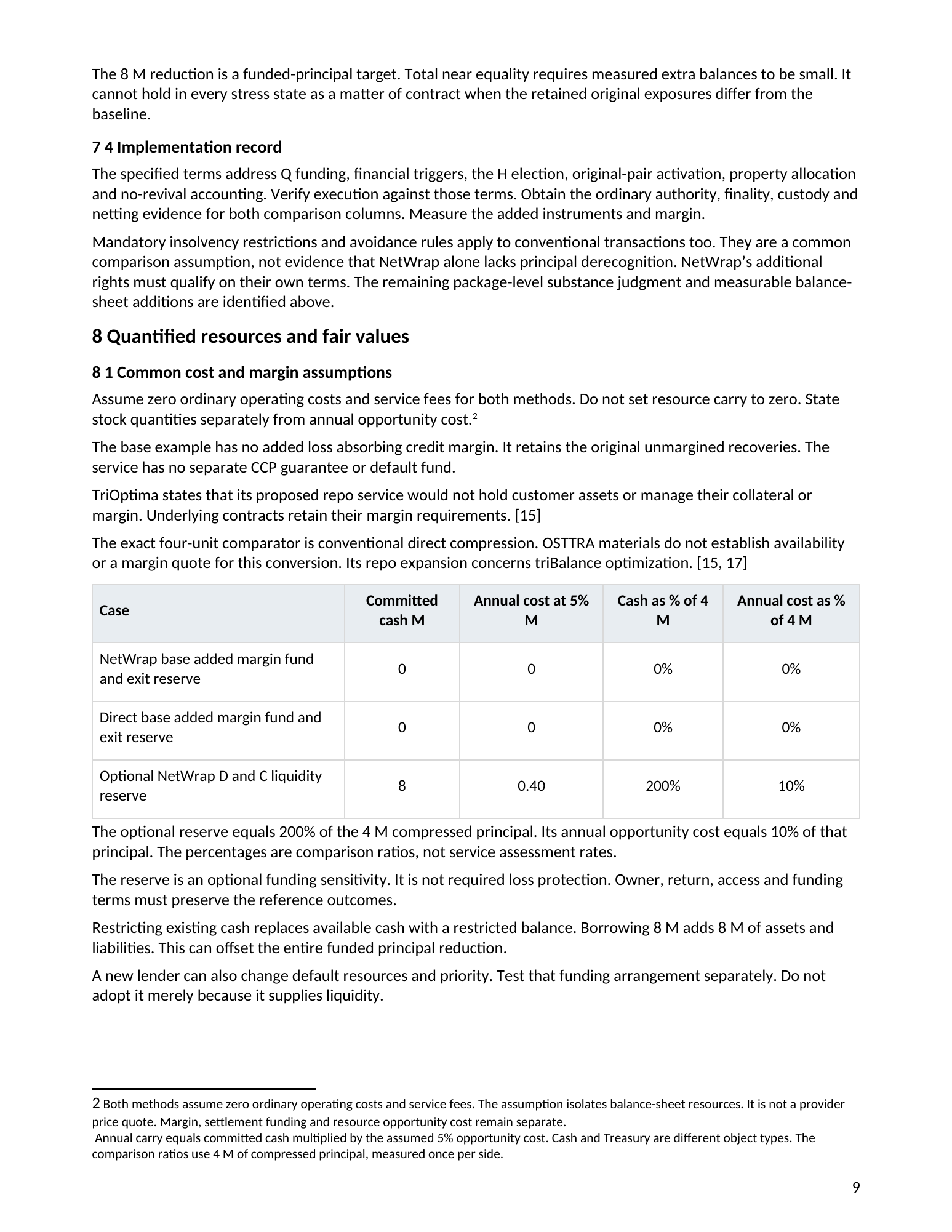
The exact four-unit comparator is conventional direct compression. OSTTRA materials do not establish availability or a margin quote for this conversion. Its repo expansion concerns triBalance optimization. [15, 17]
Case | Committed cash M | Annual cost at 5% M | Cash as % of 4 M | Annual cost as % of 4 M |
|---|---|---|---|---|
NetWrap base added margin fund and exit reserve | 0 | 0 | 0% | 0% |
Direct base added margin fund and exit reserve | 0 | 0 | 0% | 0% |
Optional NetWrap D and C liquidity reserve | 8 | 0.40 | 200% | 10% |
The optional reserve equals 200% of the 4 M compressed principal. Its annual opportunity cost equals 10% of that principal. The percentages are comparison ratios, not service assessment rates.
The reserve is an optional funding sensitivity. It is not required loss protection. Owner, return, access and funding terms must preserve the reference outcomes.
Restricting existing cash replaces available cash with a restricted balance. Borrowing 8 M adds 8 M of assets and liabilities. This can offset the entire funded principal reduction.
A new lender can also change default resources and priority. Test that funding arrangement separately. Do not adopt it merely because it supplies liquidity.
8 2 Exact settlement capacity
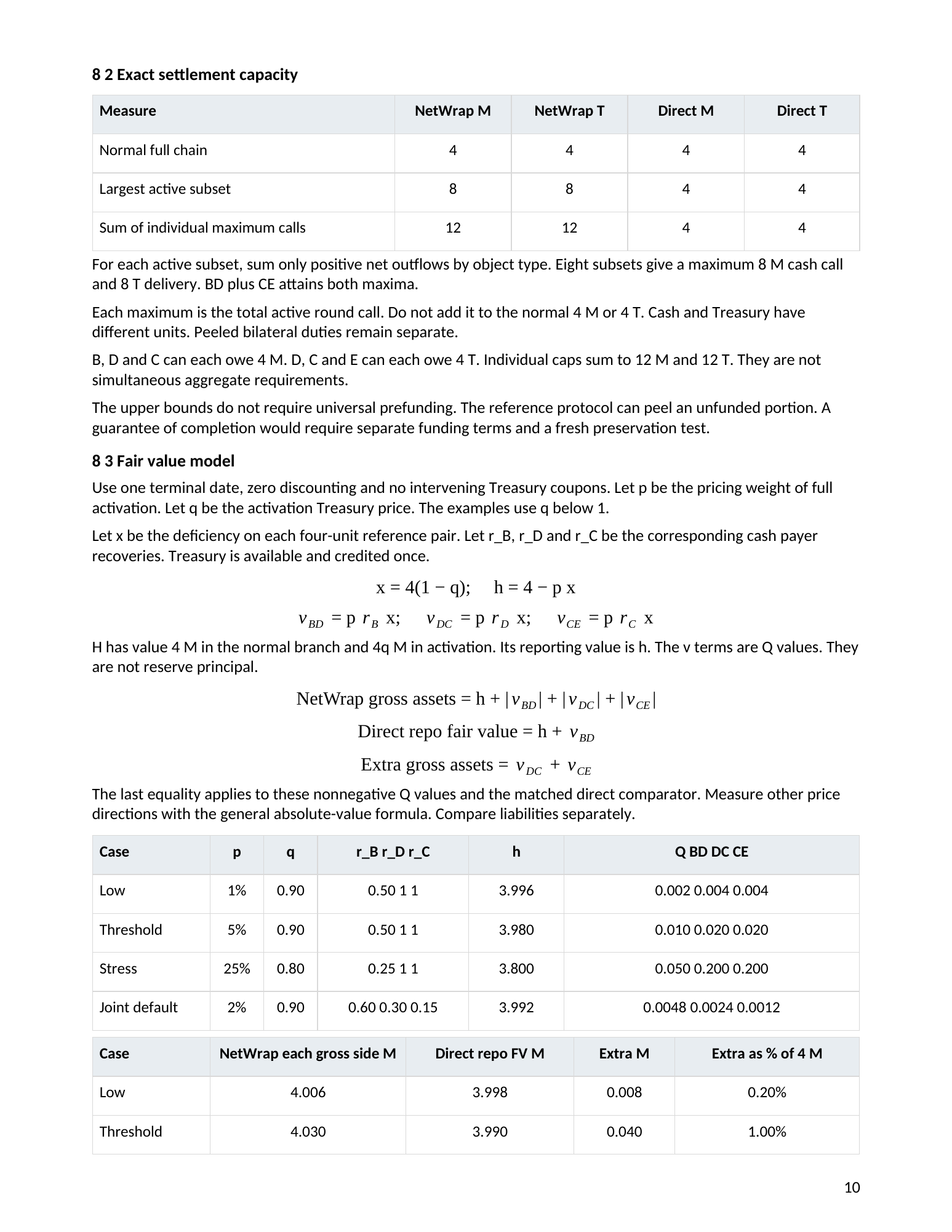
Measure | NetWrap M | NetWrap T | Direct M | Direct T |
|---|---|---|---|---|
Normal full chain | 4 | 4 | 4 | 4 |
Largest active subset | 8 | 8 | 4 | 4 |
Sum of individual maximum calls | 12 | 12 | 4 | 4 |
For each active subset, sum only positive net outflows by object type. Eight subsets give a maximum 8 M cash call and 8 T delivery. BD plus CE attains both maxima.
Each maximum is the total active round call. Do not add it to the normal 4 M or 4 T. Cash and Treasury have different units. Peeled bilateral duties remain separate.
B, D and C can each owe 4 M. D, C and E can each owe 4 T. Individual caps sum to 12 M and 12 T. They are not simultaneous aggregate requirements.
The upper bounds do not require universal prefunding. The reference protocol can peel an unfunded portion. A guarantee of completion would require separate funding terms and a fresh preservation test.
8 3 Fair value model
Use one terminal date, zero discounting and no intervening Treasury coupons. Let p be the pricing weight of full activation. Let q be the activation Treasury price. The examples use q below 1.
Let x be the deficiency on each four-unit reference pair. Let r_B, r_D and r_C be the corresponding cash payer recoveries. Treasury is available and credited once.
H has value 4 M in the normal branch and 4q M in activation. Its reporting value is h. The v terms are Q values. They are not reserve principal.
The last equality applies to these nonnegative Q values and the matched direct comparator. Measure other price directions with the general absolute-value formula. Compare liabilities separately.
Case | p | q | r_B r_D r_C | h | Q BD DC CE |
|---|---|---|---|---|---|
Low | 1% | 0.90 | 0.50 1 1 | 3.996 | 0.002 0.004 0.004 |
Threshold | 5% | 0.90 | 0.50 1 1 | 3.980 | 0.010 0.020 0.020 |
Stress | 25% | 0.80 | 0.25 1 1 | 3.800 | 0.050 0.200 0.200 |
Joint default | 2% | 0.90 | 0.60 0.30 0.15 | 3.992 | 0.0048 0.0024 0.0012 |
Case | NetWrap each gross side M | Direct repo FV M | Extra M | Extra as % of 4 M |
|---|---|---|---|---|
Low | 4.006 | 3.998 | 0.008 | 0.20% |
Threshold | 4.030 | 3.990 | 0.040 | 1.00% |
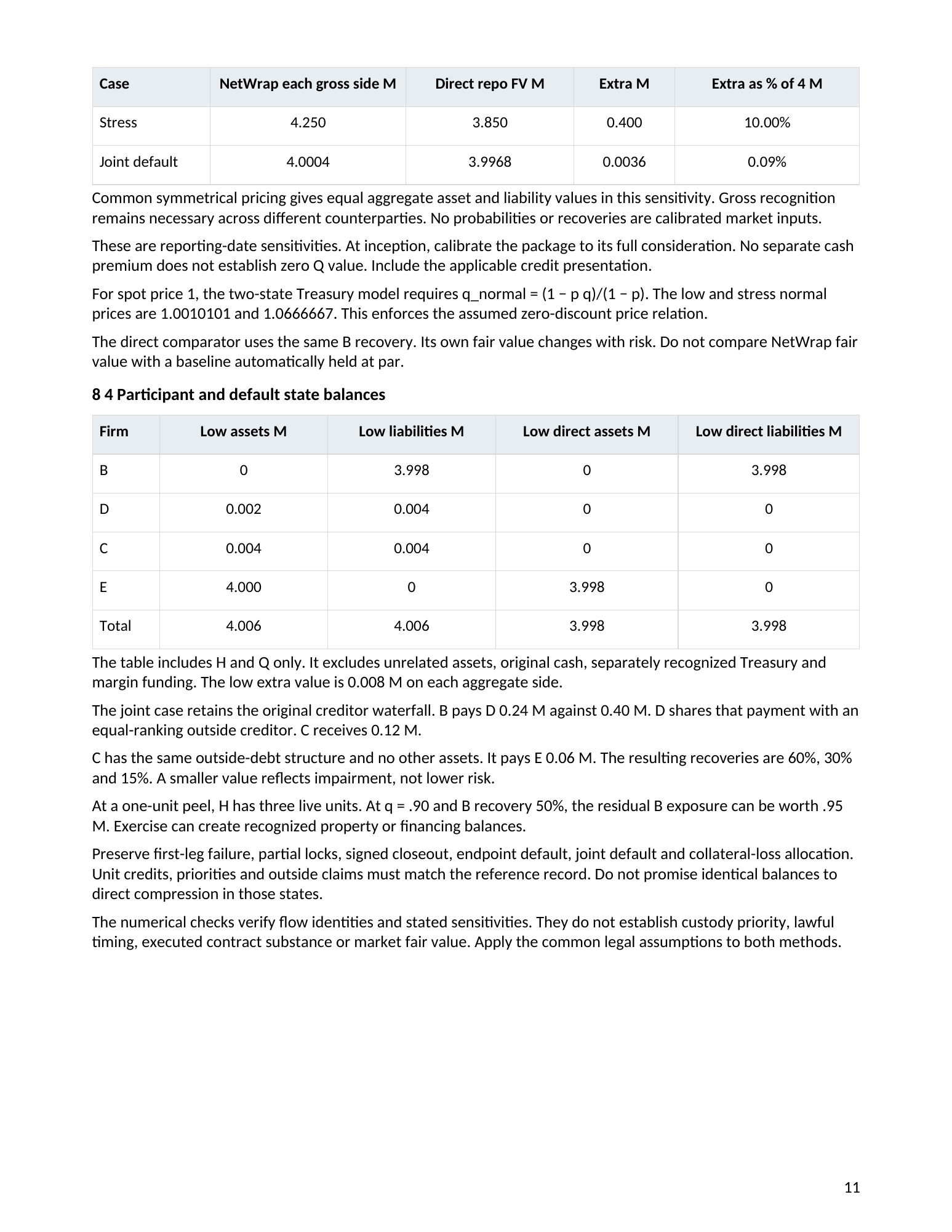
Stress | 4.250 | 3.850 | 0.400 | 10.00% |
Joint default | 4.0004 | 3.9968 | 0.0036 | 0.09% |
Common symmetrical pricing gives equal aggregate asset and liability values in this sensitivity. Gross recognition remains necessary across different counterparties. No probabilities or recoveries are calibrated market inputs.
These are reporting-date sensitivities. At inception, calibrate the package to its full consideration. No separate cash premium does not establish zero Q value. Include the applicable credit presentation.
For spot price 1, the two-state Treasury model requires q_normal = (1 − p q)/(1 − p). The low and stress normal prices are 1.0010101 and 1.0666667. This enforces the assumed zero-discount price relation.
The direct comparator uses the same B recovery. Its own fair value changes with risk. Do not compare NetWrap fair value with a baseline automatically held at par.
8 4 Participant and default state balances
Firm | Low assets M | Low liabilities M | Low direct assets M | Low direct liabilities M |
|---|---|---|---|---|
B | 0 | 3.998 | 0 | 3.998 |
D | 0.002 | 0.004 | 0 | 0 |
C | 0.004 | 0.004 | 0 | 0 |
E | 4.000 | 0 | 3.998 | 0 |
Total | 4.006 | 4.006 | 3.998 | 3.998 |
The table includes H and Q only. It excludes unrelated assets, original cash, separately recognized Treasury and margin funding. The low extra value is 0.008 M on each aggregate side.
The joint case retains the original creditor waterfall. B pays D 0.24 M against 0.40 M. D shares that payment with an equal-ranking outside creditor. C receives 0.12 M.
C has the same outside-debt structure and no other assets. It pays E 0.06 M. The resulting recoveries are 60%, 30% and 15%. A smaller value reflects impairment, not lower risk.
At a one-unit peel, H has three live units. At q = .90 and B recovery 50%, the residual B exposure can be worth .95 M. Exercise can create recognized property or financing balances.
Preserve first-leg failure, partial locks, signed closeout, endpoint default, joint default and collateral-loss allocation. Unit credits, priorities and outside claims must match the reference record. Do not promise identical balances to direct compression in those states.
The numerical checks verify flow identities and stated sensitivities. They do not establish custody priority, lawful timing, executed contract substance or market fair value. Apply the common legal assumptions to both methods.
9 Sources
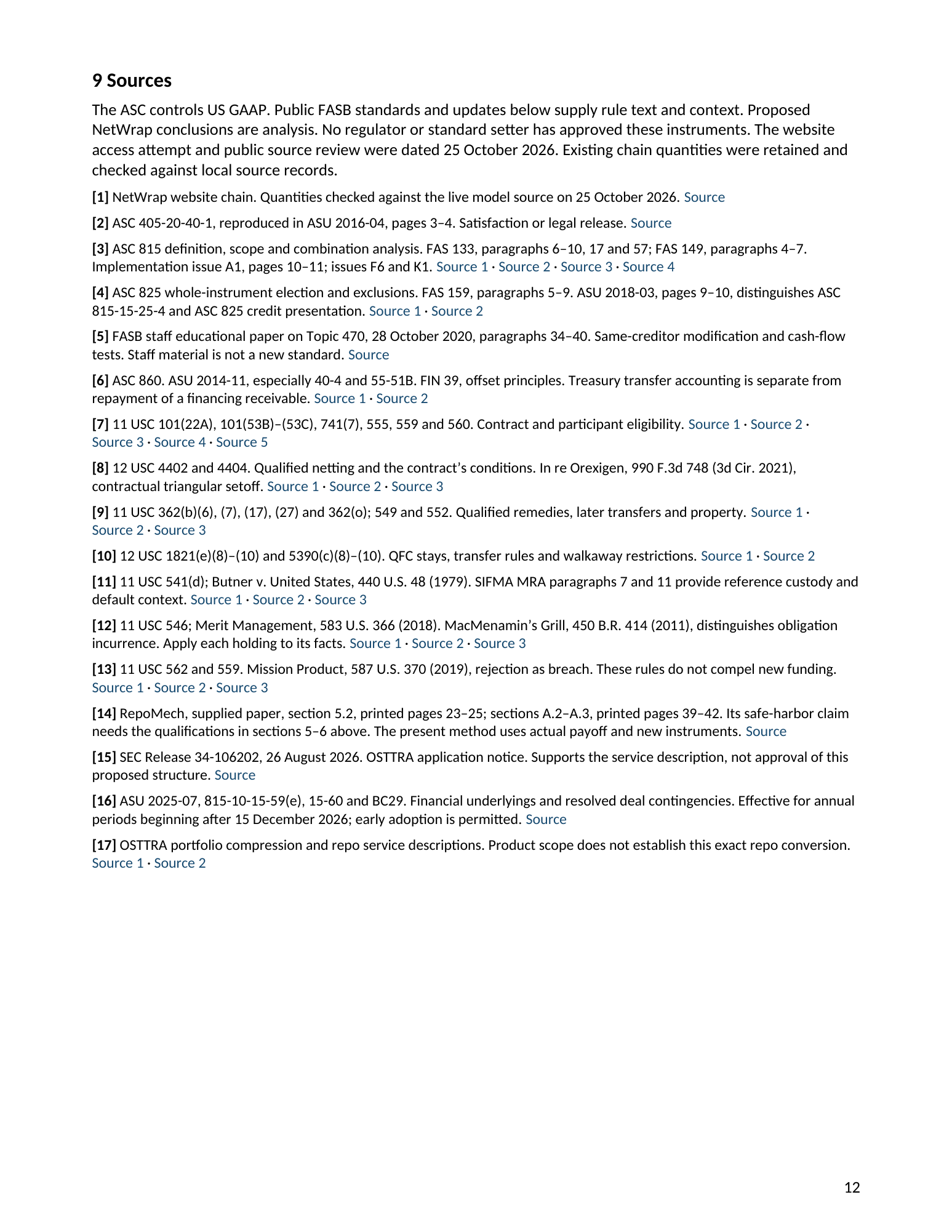
The ASC controls US GAAP. Public FASB standards and updates below supply rule text and context. Proposed NetWrap conclusions are analysis. No regulator or standard setter has approved these instruments. The website access attempt and public source review were dated 25 October 2026. Existing chain quantities were retained and checked against local source records.
[1] NetWrap website chain. Quantities checked against the live model source on 25 October 2026. Source
[2] ASC 405-20-40-1, reproduced in ASU 2016-04, pages 3–4. Satisfaction or legal release. Source
[3] ASC 815 definition, scope and combination analysis. FAS 133, paragraphs 6–10, 17 and 57; FAS 149, paragraphs 4–7. Implementation issue A1, pages 10–11; issues F6 and K1. Source 1 · Source 2 · Source 3 · Source 4
[4] ASC 825 whole-instrument election and exclusions. FAS 159, paragraphs 5–9. ASU 2018-03, pages 9–10, distinguishes ASC 815-15-25-4 and ASC 825 credit presentation. Source 1 · Source 2
[5] FASB staff educational paper on Topic 470, 28 October 2020, paragraphs 34–40. Same-creditor modification and cash-flow tests. Staff material is not a new standard. Source
[6] ASC 860. ASU 2014-11, especially 40-4 and 55-51B. FIN 39, offset principles. Treasury transfer accounting is separate from repayment of a financing receivable. Source 1 · Source 2
[7] 11 USC 101(22A), 101(53B)–(53C), 741(7), 555, 559 and 560. Contract and participant eligibility. Source 1 · Source 2 · Source 3 · Source 4 · Source 5
[8] 12 USC 4402 and 4404. Qualified netting and the contract’s conditions. In re Orexigen, 990 F.3d 748 (3d Cir. 2021), contractual triangular setoff. Source 1 · Source 2 · Source 3
[9] 11 USC 362(b)(6), (7), (17), (27) and 362(o); 549 and 552. Qualified remedies, later transfers and property. Source 1 · Source 2 · Source 3
[10] 12 USC 1821(e)(8)–(10) and 5390(c)(8)–(10). QFC stays, transfer rules and walkaway restrictions. Source 1 · Source 2
[11] 11 USC 541(d); Butner v. United States, 440 U.S. 48 (1979). SIFMA MRA paragraphs 7 and 11 provide reference custody and default context. Source 1 · Source 2 · Source 3
[12] 11 USC 546; Merit Management, 583 U.S. 366 (2018). MacMenamin’s Grill, 450 B.R. 414 (2011), distinguishes obligation incurrence. Apply each holding to its facts. Source 1 · Source 2 · Source 3
[13] 11 USC 562 and 559. Mission Product, 587 U.S. 370 (2019), rejection as breach. These rules do not compel new funding. Source 1 · Source 2 · Source 3
[14] RepoMech, supplied paper, section 5.2, printed pages 23–25; sections A.2–A.3, printed pages 39–42. Its safe-harbor claim needs the qualifications in sections 5–6 above. The present method uses actual payoff and new instruments. Source
[15] SEC Release 34-106202, 26 August 2026. OSTTRA application notice. Supports the service description, not approval of this proposed structure. Source
[16] ASU 2025-07, 815-10-15-59(e), 15-60 and BC29. Financial underlyings and resolved deal contingencies. Effective for annual periods beginning after 15 December 2026; early adoption is permitted. Source
[17] OSTTRA portfolio compression and repo service descriptions. Product scope does not establish this exact repo conversion. Source 1 · Source 2
Exposure identity and amount
Counterparty exposure identity. Identity means the original pair to which an unpaid obligation or default loss belongs. NetWrap retains that pair and its specified reference recovery rights. A direct settlement route does not itself replace the party bearing the loss.
Counterparty exposure amount. Amount requires a stated measure. For settlement, it is the cash or securities that each participant must lock for the active group. For credit loss, it is the unrecovered reference claim after closeout, collateral and estate recoveries. These are different amounts. The website phrase “original counterparty exposure preserved and reduced” refers to identity retained and settlement funding netted down.
Net funding and the shortfall bound. For participant i and object k in a fixed active group, let G be gross outgoing obligations and A be incoming obligations. The net lock requirement is R = max(G - A, 0), so 0 <= R <= G. With usable funding F >= 0, the lock shortfall is max(R - F, 0) <= max(G - F, 0). Netting therefore weakly reduces the maximum shortfall on that round’s funding call. A participant without offsetting inflows may have no reduction. Cash and securities remain separate objects.
Recalculation after a failure. A peel changes the active group and can raise a survivor’s call relative to the previous net call. Apply the bound to that new group. Peeled obligations remain separately enforceable; their removal is not an additional saving or a reduction in the reference creditor’s loss.
Value at risk. Statistical value at risk (VaR) is a loss quantile for a stated horizon and probability model. A lower funding requirement alone does not establish lower default-loss VaR. If each participant has the same loss in every reference state, with the same state probabilities, its default-loss VaR is unchanged. Reduced liquidity pressure can affect default probabilities or funding costs in a broader model, but those effects require calibration. No strict VaR reduction for every participant is established here.
Amounts in the compression example. Normal settlement uses 4 M and 4 T instead of 12 M and 12 T gross, a 66.7% reduction in each object. Across active subsets, the separate maxima are 8 M and 8 T. In the stated B default example, D still bears the same 0.2 M reference loss. The smaller normal lock amount does not reduce that preserved loss.
Risk reduction and margin. Less cash and fewer securities needed for settlement can ease liquidity pressure while original pairs retain default responsibility. The zero added margin, default fund and exit reserve remain assumptions of the unmargined comparison; they are not a waiver of agreed bilateral margin or an existing clearinghouse’s requirements.
Footnotes
NetWrap parties may agree bilateral margin for retained default exposure. Agreements and law may permit covered trades with the same legal counterparty to share collateral. The replacement contracts do not themselves create that right. FICC requirements remain governed by its rules.
Eligible Treasury and CME futures positions can receive FICC–CME cross-margin reductions. A participant cannot deduct an unrelated margin receipt from its FICC deposit. Preserve each reference contract's existing collateral, setoff, custody and recovery rights. Apply applicable customer-fund segregation rules.
See the DTCC FICC–CME cross-margining program.
↩Both methods assume zero ordinary operating costs and service fees. The assumption isolates balance-sheet resources. It is not a provider price quote. Margin, settlement funding and resource opportunity cost remain separate.
Annual carry equals committed cash multiplied by the assumed 5% opportunity cost. Cash and Treasury are different object types. The comparison ratios use 4 M of compressed principal, measured once per side.
↩