Contents
5 November 2026 Proposed structure under US GAAP
1 Method and result
Use H as the principal central counterparty. At execution, sign the repo novation and the K, R and Q contracts. These contracts retain the original exchanges and default recovery allocations. The annex gives their terms and the analysis of H default. Counterparty identity is retained while settlement funding amounts are netted down. The final section distinguishes these amounts from preserved default losses and statistical VaR.
Both methods show 21 M of net repo assets and 21 M of net repo liabilities for the website portfolio. NetWrap adds contract fair values. FICC adds required member risk deposits. The prospective comparison uses FICC’s published Guaranty Fund proposal, subject to approval. [1–4]
2 Portfolio and principal presentation
Seven repos total 47 M and 14 T. T is one Treasury CUSIP. Set 1 M equal to $1 million. Each first leg settles gross. Normal second-leg settlement uses 21 M and 5 T. Ignore repo interest and service fees in this principal comparison. [1]
Member | Gross assets M | Gross liabilities M | Net principal in either method |
|---|---|---|---|
A | 9 | 0 | 9 asset |
B | 25 | 16 | 9 asset |
C | 4 | 9 | 5 liability |
D | 7 | 4 | 3 asset |
E | 0 | 6 | 6 liability |
F | 2 | 12 | 10 liability |
Total | 47 | 47 | 21 assets and 21 liabilities |
Eligible repo offsetting reduces each principal side by 26 M, or 55.3%. Apply ASC 210-20-45-11 and its settlement conditions. The funded repos remain recognized. H cannot offset claims against different members. Recognize the added contracts and collateral separately. [2]
3 Execution and settlement
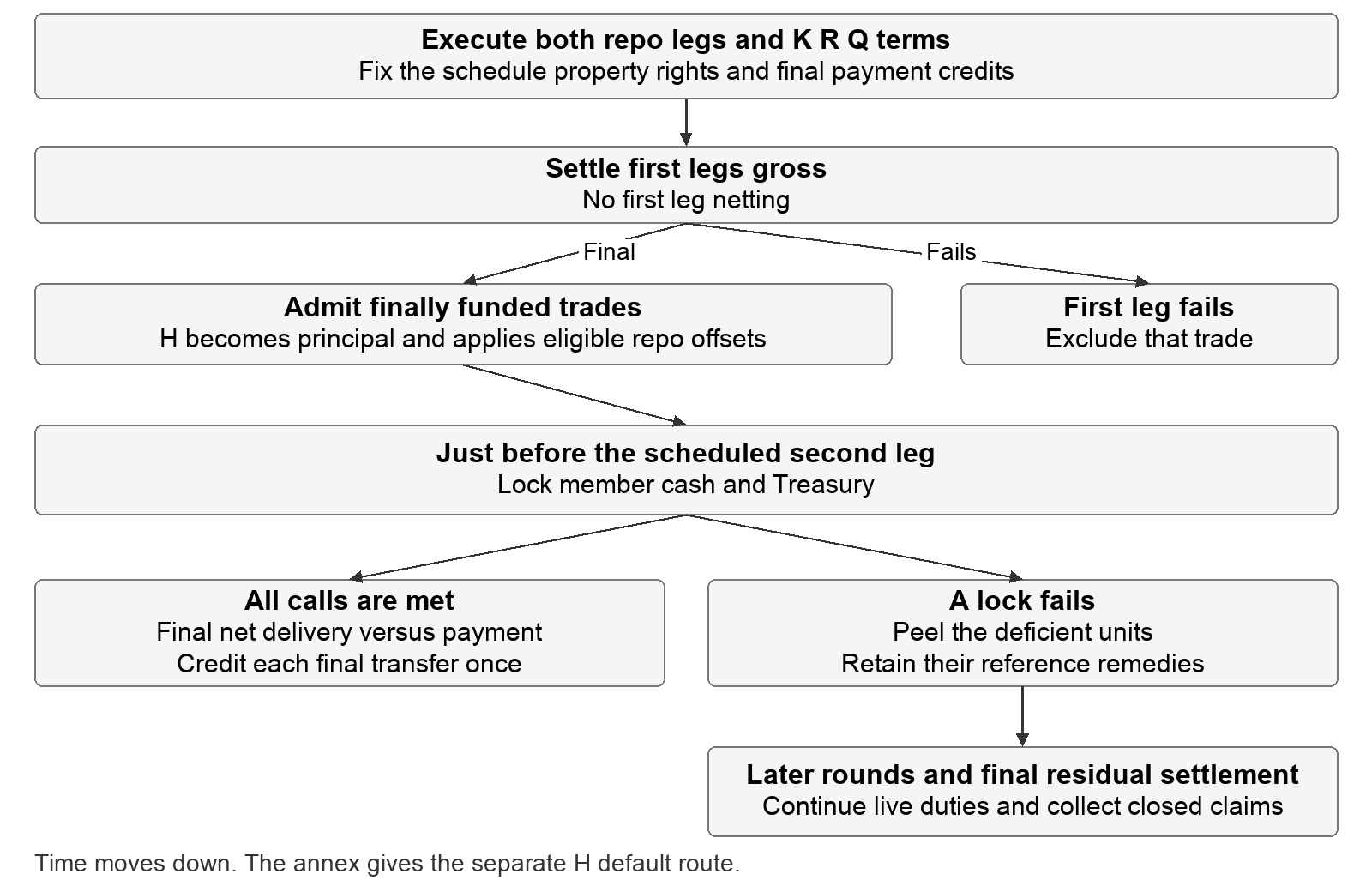
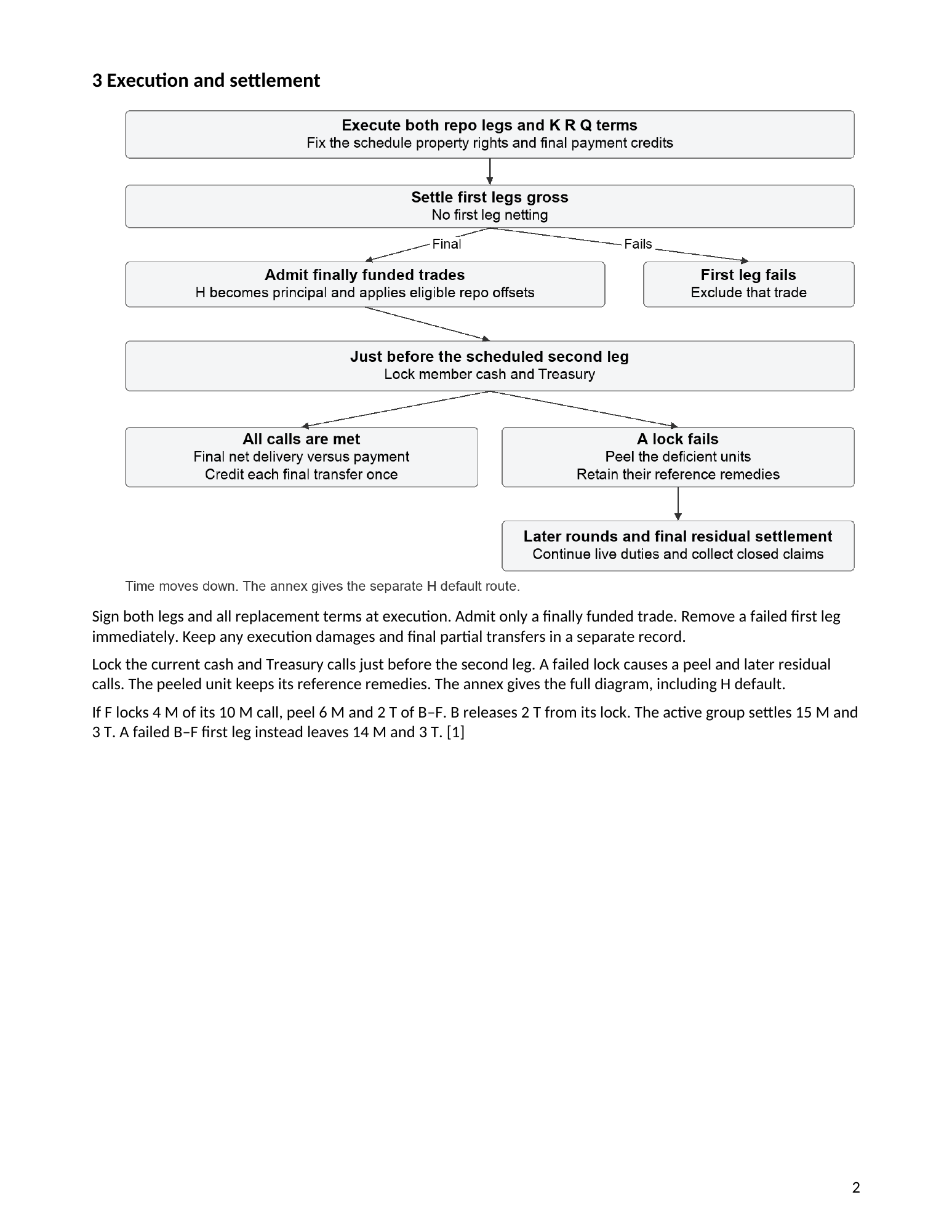
Sign both legs and all replacement terms at execution. Admit only a finally funded trade. Remove a failed first leg immediately. Keep any execution damages and final partial transfers in a separate record.
Lock the current cash and Treasury calls just before the second leg. A failed lock causes a peel and later residual calls. The peeled unit keeps its reference remedies. The annex gives the full diagram, including H default.
If F locks 4 M of its 10 M call, peel 6 M and 2 T of B–F. B releases 2 T from its lock. The active group settles 15 M and 3 T. A failed B–F first leg instead leaves 14 M and 3 T. [1]
4 Margin reserves and participant balances
Use zero ordinary operating expense for both methods. The exact NetWrap model needs zero H prefunding for reference credit losses or unmatched settlement advances. It requires no default-fund or CCP margin deposits for reference risk in this exact model. The annex calculates this result and states the contract conditions. [3]1
Actual implementation can require extra resources J for added custody, timing or credit risks. Size J from those exposures. Do not treat an unmeasured J as zero. Participant settlement calls are separate: 21 M and 5 T normally, with active-subset maxima of 25 M and 7 T.
Participant asset or liability M | FICC proposed rules | NetWrap |
|---|---|---|
Net repo assets / liabilities | 21 / 21 | 21 / 21 |
Guaranty Fund deposit asset | 6 + Γ | 0 in the model |
Initial margin deposit asset | I | 0 in the unmargined reference |
Retained cash from equal starting resources | 0 | 6 + I + Γ |
Selected assets including retained cash | 27 + I + Γ | 27 + I + Γ |
I is calculated FICC initial margin in M. Γ is the aggregate Guaranty Fund contribution above the six member minimums, also in M. Both inputs remain unmeasured. The 6 M minimum assumes six separate direct dealer memberships whose full minimum contributions enter this comparison.
The minimum is per member, not per trade group. Existing members need a whole-portfolio before-and-after calculation. Posting existing cash reclassifies an asset. It restricts cash use but does not by itself increase total assets. Add contract values and funding debt where applicable. [4]
NetWrap participants can agree bilateral margin for retained exposure. Apply the same existing collateral and setoff rights in every reference default state. The margin footnote explains cross-product limits and the FICC and CME exception. [4]2
5 Fund cost and added contract values
Resource case | Annual lost profit at 5% | Resources as percent of 21 M | Annual cost as percent of 21 M |
|---|---|---|---|
FICC Guaranty Fund floor 6 M | $300,000 | 28.5714% | 1.4286% |
FICC calculated initial margin I M | $50,000 × I | 100I / 21 % | 5I / 21 % |
FICC fund above floor Γ M | $50,000 × Γ | 100Γ / 21 % | 5Γ / 21 % |
FICC total 6 + I + Γ M | $300,000 + $50,000(I + Γ) | 100(6 + I + Γ) / 21 % | 5(6 + I + Γ) / 21 % |
NetWrap modeled structural resources 0 M | $0 | 0% | 0% |
The denominator is 21 M of netted repo principal per side, measured at one time. It is not annual turnover or eliminated volume. The ratios describe this example. They are not FICC assessment rates. The 5% is net of resource income and represents annual opportunity cost.
FICC proposes separate calculated initial margin and a cash Guaranty Fund. The initial fund minimum is 1 M per member. A zero minimum margin charge does not remove calculated margin. The annex applies the allocation formula and shows a clearly assumed stress sensitivity. [4]
The first-cycle mark illustration transfers 9.5 M from payers to recipients. It is separate from the fund and initial margin. It is not idle system capital. Actual mark calls require the missing settlement inputs. [5]
The annex gives an uncalibrated sensitivity for separate derivative units before Q performance. Added assets and liabilities are 0.255 M each at a 1% weight, or 1.275 M at 5%. These are not values of the final operative Q and discharge-credit package. Include those credits and the actual accounting units in valuation. [6]
For each additional 1 M of usable NetWrap resources J, annual opportunity cost is $50,000. Corporate business capital remains outside both participant comparisons. Equal net principal does not establish equal total assets or equal guarantees.
6 Sources
[1] NetWrap overview, central clearing; seven-trade website example. Source
[2] ASC 210-20-45-11; FIN 41 paragraphs 3–4; FIN 39. Source 1 · Source 2 · Source 3
[3] 17 CFR 240.17ad-22(e)(4), (6), (7), (15): risk resources and business capital. Source
[4] FICC proposal SR-FICC-2026-008 as amended. Pages 21–22, 39–40 and 70. Draft Rule 4A and CME cross-margining. Source 1 · Source 2 · Source 3
[5] DTCC DVP Funds-Only Settlement; annex states mark assumptions. Source
[6] ASC 405-20-40-2, ASC 460, ASC 815 and ASC 820; public FASB background. Source 1 · Source 2 · Source 3 · Source 4
[7] SEC CCP definition release; Treasury clearing release. Source 1 · Source 2
Exposure identity and amount
Counterparty exposure identity. Identity means the original pair to which an unpaid obligation or default loss belongs. NetWrap retains that pair and its specified reference recovery rights. A direct settlement route does not itself replace the party bearing the loss.
Counterparty exposure amount. Amount requires a stated measure. For settlement, it is the cash or securities that each participant must lock for the active group. For credit loss, it is the unrecovered reference claim after closeout, collateral and estate recoveries. These are different amounts. The website phrase “original counterparty exposure preserved and reduced” refers to identity retained and settlement funding netted down.
Net funding and the shortfall bound. For participant i and object k in a fixed active group, let G be gross outgoing obligations and A be incoming obligations. The net lock requirement is R = max(G - A, 0), so 0 <= R <= G. With usable funding F >= 0, the lock shortfall is max(R - F, 0) <= max(G - F, 0). Netting therefore weakly reduces the maximum shortfall on that round’s funding call. A participant without offsetting inflows may have no reduction. Cash and securities remain separate objects.
Recalculation after a failure. A peel changes the active group and can raise a survivor’s call relative to the previous net call. Apply the bound to that new group. Peeled obligations remain separately enforceable; their removal is not an additional saving or a reduction in the reference creditor’s loss.
Value at risk. Statistical value at risk (VaR) is a loss quantile for a stated horizon and probability model. A lower funding requirement alone does not establish lower default-loss VaR. If each participant has the same loss in every reference state, with the same state probabilities, its default-loss VaR is unchanged. Reduced liquidity pressure can affect default probabilities or funding costs in a broader model, but those effects require calibration. No strict VaR reduction for every participant is established here.
Amounts in the clearing example. Normal second-leg settlement uses 21 M and 5 T instead of 47 M and 14 T gross, reductions of 55.3% and 64.3%, respectively. Across active subsets, the separate maxima are 25 M and 7 T. These are settlement requirements, not measures of default credit loss.
Default fund and margin deposits. The exact principal-CCP contract package leaves H with zero reference credit loss and no unmatched settlement advance. It therefore needs zero default-fund and CCP margin deposits for those modeled risks. This removes mutualization of reference losses; the original pairs retain them. Settlement locks, agreed bilateral margin, collateral securing original repos and resources J for added risks remain separate. Applicable CCP rules and regulatory resource requirements remain binding unless validly changed.
Relation to the SEC systemic risk objective. The SEC identifies lower settlement-failure exposure as a benefit of multilateral netting. NetWrap’s smaller funding calls can contribute to that objective without mutualizing reference losses. This is an inference about the settlement-liquidity channel, not a proof of lower total system risk or compliance with the central-clearing mandate. Existing guarantees, margin and operational safeguards require their own assessment.
Source: SEC Release 34-99149 (13 December 2023), pp. 15–16 and 288–289. Treasury clearing final rule
Footnotes
Default assumption: Annual ordinary operating expense is zero for NetWrap and the comparison service. Corporate business capital and recovery or wind-down overhead are outside both transaction comparisons. Those exclusions do not establish zero actual regulatory capital.
↩NetWrap participants may agree bilateral margin for their retained default exposure. Their agreements and applicable law can permit collateral offsets or net cash margin calls across covered trades with the same legal counterparty. R does not itself create that right. The reference recovery calculation must retain the agreed collateral and setoff rights.
NetWrap nets specified funding flows and does not itself create portfolio margin offsets. FICC deposits follow FICC rules. Eligible Treasury and CME futures positions can receive margin reductions through the FICC and CME program. A claim against another counterparty does not itself discharge a FICC deposit.
See source 4 and annex sources 20 and 21.
↩