

Contents
- 1 Scope and formation
- 1 1 Execute the complete package
- 1 2 Settlement and presentation
- Full execution and default timeline
- 2 Signed closeout and live trade continuation
- 2 1 Classify each reference unit
- 2 2 Closed claims and actual recovery
- 2 3 Present secondary performance contract Q
- 3 Worked exits and joint defaults
- 3 1 H alone exits while all seven trades remain live
- 3 2 F defaults; only B F and F E lawfully close
- 3 3 All and sequential default states
- 4 Property timing and legal continuity
- 4 1 Current property and collection rights
- 4 2 H only resolution at the maturity deadline
- 4 3 Reference member failure and rejection
- 5 Bankruptcy protection and estate value
- 5 1 Requirements shared with conventional clearing
- 5 2 NetWrap specific protections
- 5 3 Scope of the all state result
- 5 4 CCP authorization
- 6 Actual minimum resource calculation
- 6 1 Structural transaction reserve
- 6 2 Common operating cost assumption and separate capital floor
- 6 3 Default fund and margin deposits
- 6 4 Numerical verification
- 7 FICC prospective rules and resource calculation
- 7 1 Published design and approval status
- 7 2 Margin and Guaranty Fund have separate functions
- 7 3 Membership basis and missing inputs
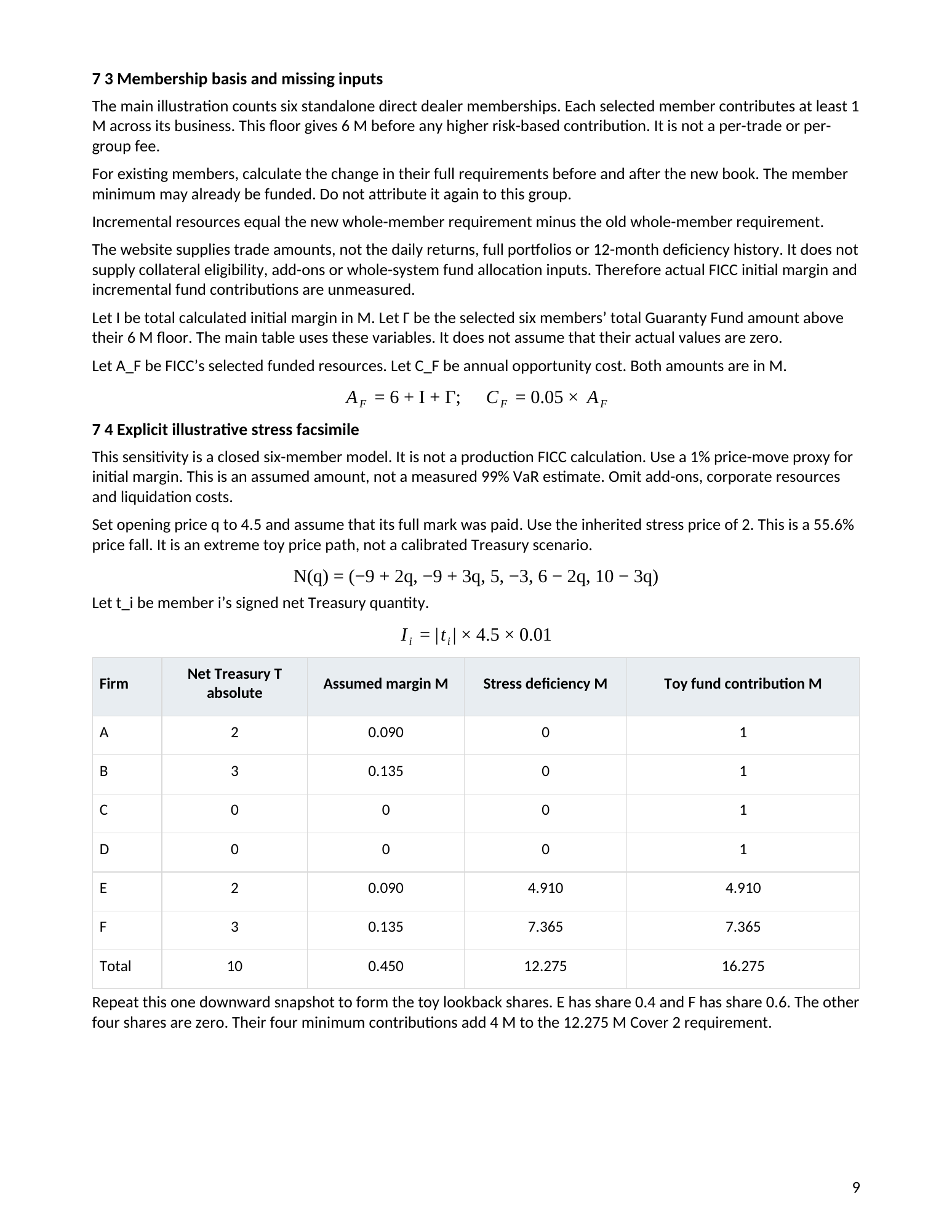
- 7 4 Explicit illustrative stress facsimile
- 7 5 Opening mark and funding
- 7 6 Current framework retained for reference
- 7 7 Bilateral margin and cross product offsets
- 8 Accounting and cost comparison
- 8 1 Legal release and secondary performance
- 8 2 Participant balance bridge
- 8 3 Five percent net lost profit
- 9 Added values and sources
- 9 1 Added values are not zero
- 10 Sources
- Exposure identity and amount
5 November 2026 Proposed structure under US GAAP
1 Scope and formation
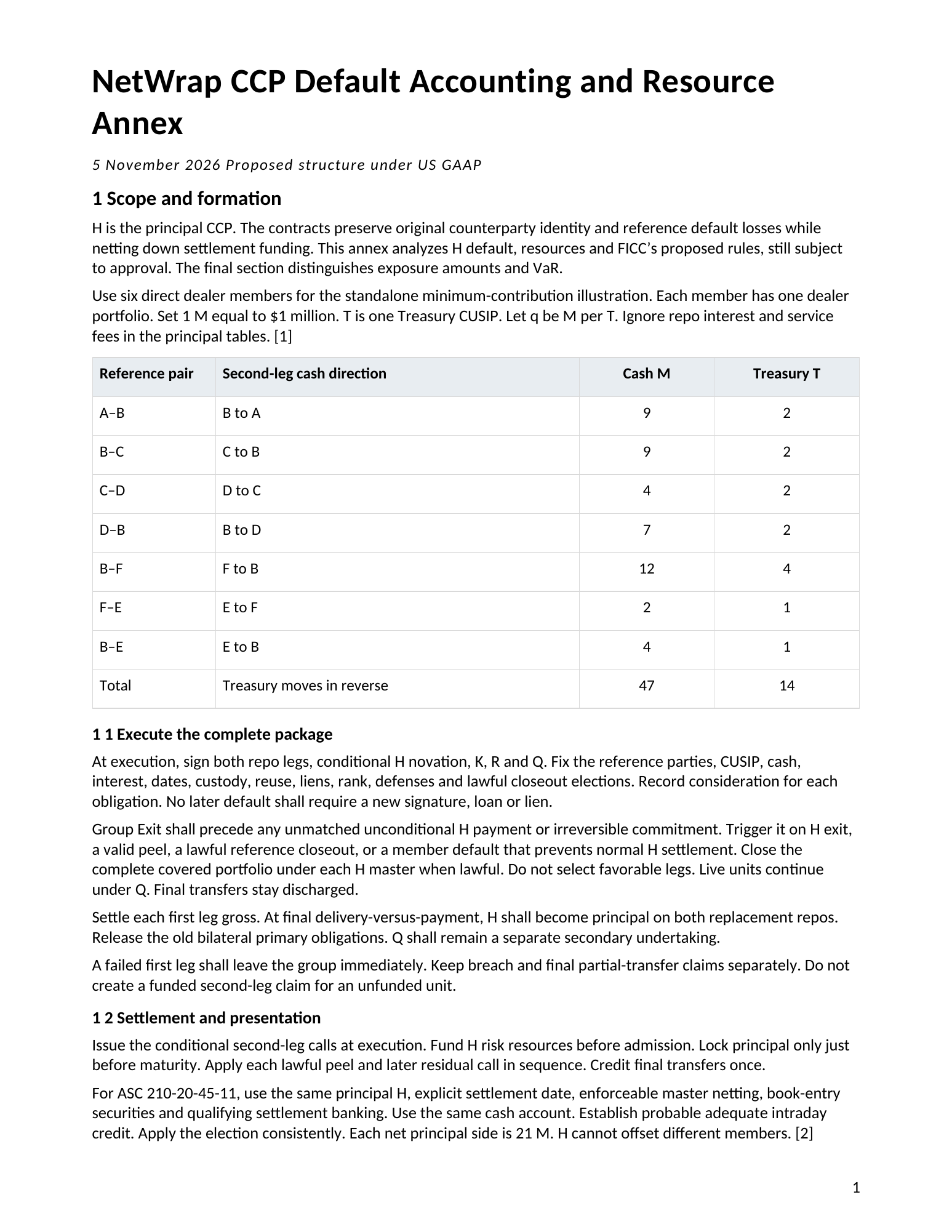
H is the principal CCP. The contracts preserve original counterparty identity and reference default losses while netting down settlement funding. This annex analyzes H default, resources and FICC’s proposed rules, still subject to approval. The final section distinguishes exposure amounts and VaR.
Use six direct dealer members for the standalone minimum-contribution illustration. Each member has one dealer portfolio. Set 1 M equal to $1 million. T is one Treasury CUSIP. Let q be M per T. Ignore repo interest and service fees in the principal tables. [1]
Reference pair | Second-leg cash direction | Cash M | Treasury T |
|---|---|---|---|
A–B | B to A | 9 | 2 |
B–C | C to B | 9 | 2 |
C–D | D to C | 4 | 2 |
D–B | B to D | 7 | 2 |
B–F | F to B | 12 | 4 |
F–E | E to F | 2 | 1 |
B–E | E to B | 4 | 1 |
Total | Treasury moves in reverse | 47 | 14 |
1 1 Execute the complete package
At execution, sign both repo legs, conditional H novation, K, R and Q. Fix the reference parties, CUSIP, cash, interest, dates, custody, reuse, liens, rank, defenses and lawful closeout elections. Record consideration for each obligation. No later default shall require a new signature, loan or lien.
Group Exit shall precede any unmatched unconditional H payment or irreversible commitment. Trigger it on H exit, a valid peel, a lawful reference closeout, or a member default that prevents normal H settlement. Close the complete covered portfolio under each H master when lawful. Do not select favorable legs. Live units continue under Q. Final transfers stay discharged.
Settle each first leg gross. At final delivery-versus-payment, H shall become principal on both replacement repos. Release the old bilateral primary obligations. Q shall remain a separate secondary undertaking.
A failed first leg shall leave the group immediately. Keep breach and final partial-transfer claims separately. Do not create a funded second-leg claim for an unfunded unit.
1 2 Settlement and presentation
Issue the conditional second-leg calls at execution. Fund H risk resources before admission. Lock principal only just before maturity. Apply each lawful peel and later residual call in sequence. Credit final transfers once.
For ASC 210-20-45-11, use the same principal H, explicit settlement date, enforceable master netting, book-entry securities and qualifying settlement banking. Use the same cash account. Establish probable adequate intraday credit. Apply the election consistently. Each net principal side is 21 M. H cannot offset different members. [2]
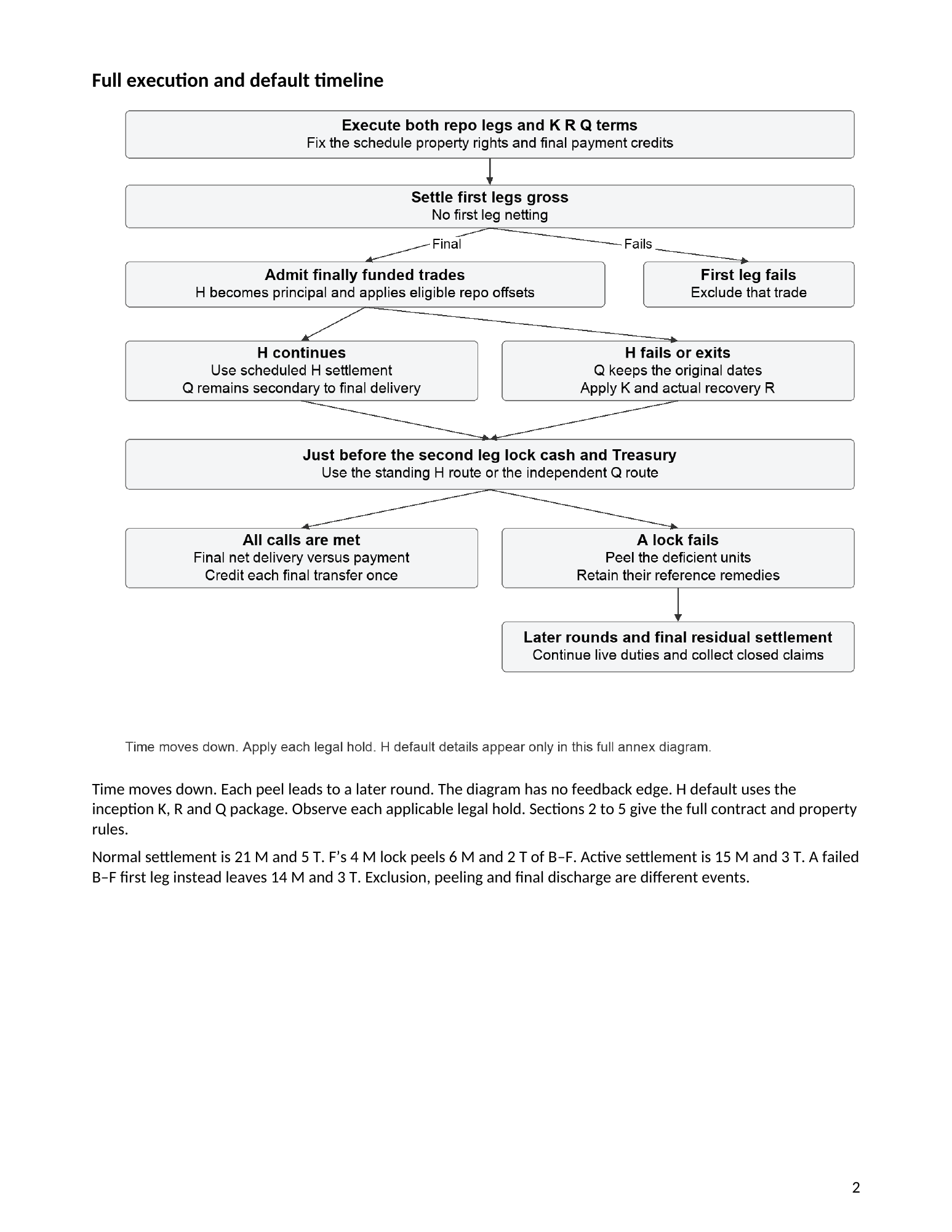
Full execution and default timeline
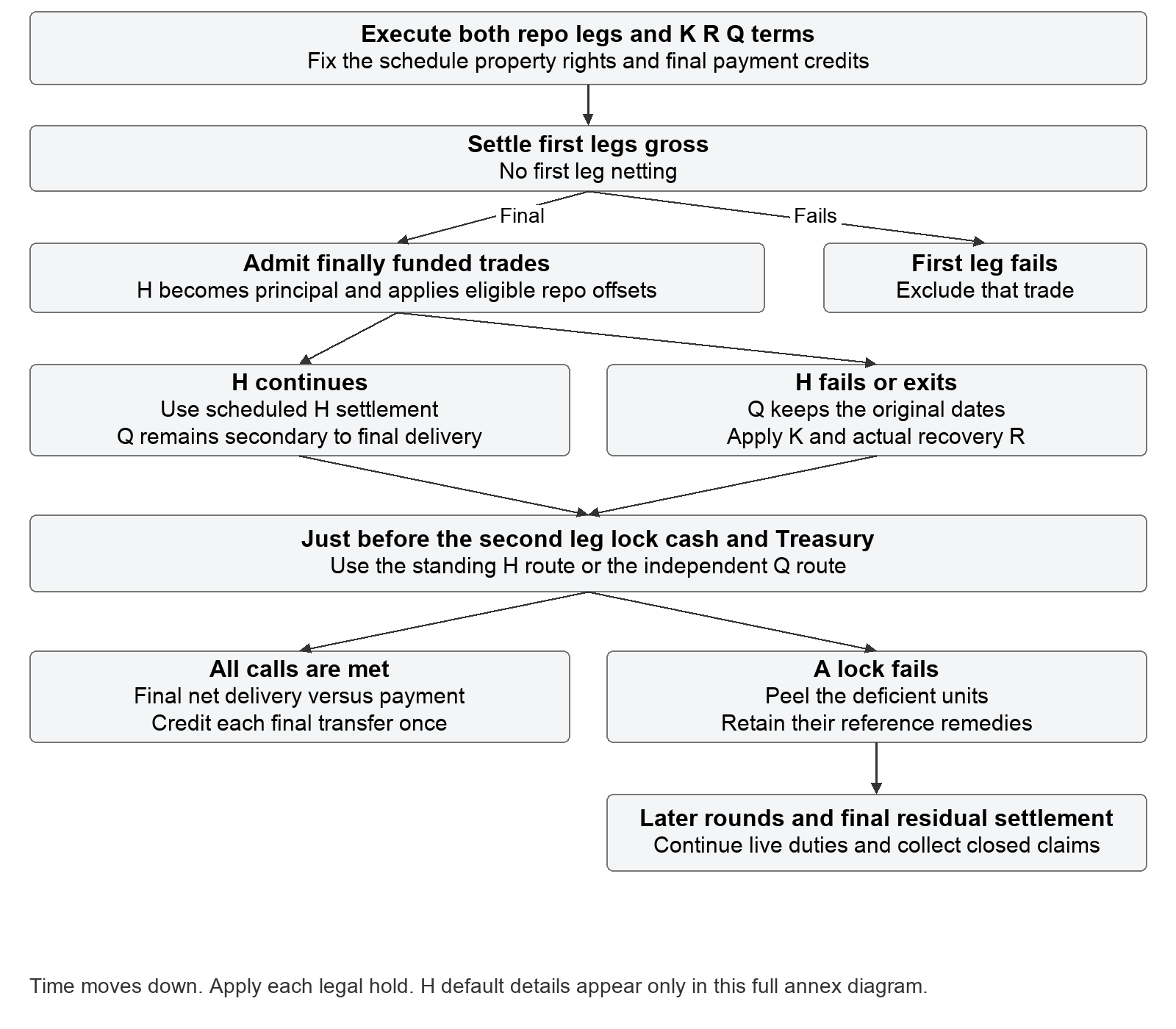
Time moves down. Each peel leads to a later round. The diagram has no feedback edge. H default uses the inception K, R and Q package. Observe each applicable legal hold. Sections 2 to 5 give the full contract and property rules.
Normal settlement is 21 M and 5 T. F’s 4 M lock peels 6 M and 2 T of B–F. Active settlement is 15 M and 3 T. A failed B–F first leg instead leaves 14 M and 3 T. Exclusion, peeling and final discharge are different events.
2 Signed closeout and live trade continuation
2 1 Classify each reference unit
C shall contain reference units already lawfully closed. L shall contain units that must remain live. Use the reference elections and law, not H’s decision to close its master. A default or peel alone does not close a reference unit. Split partially performed or partially peeled trades into units.
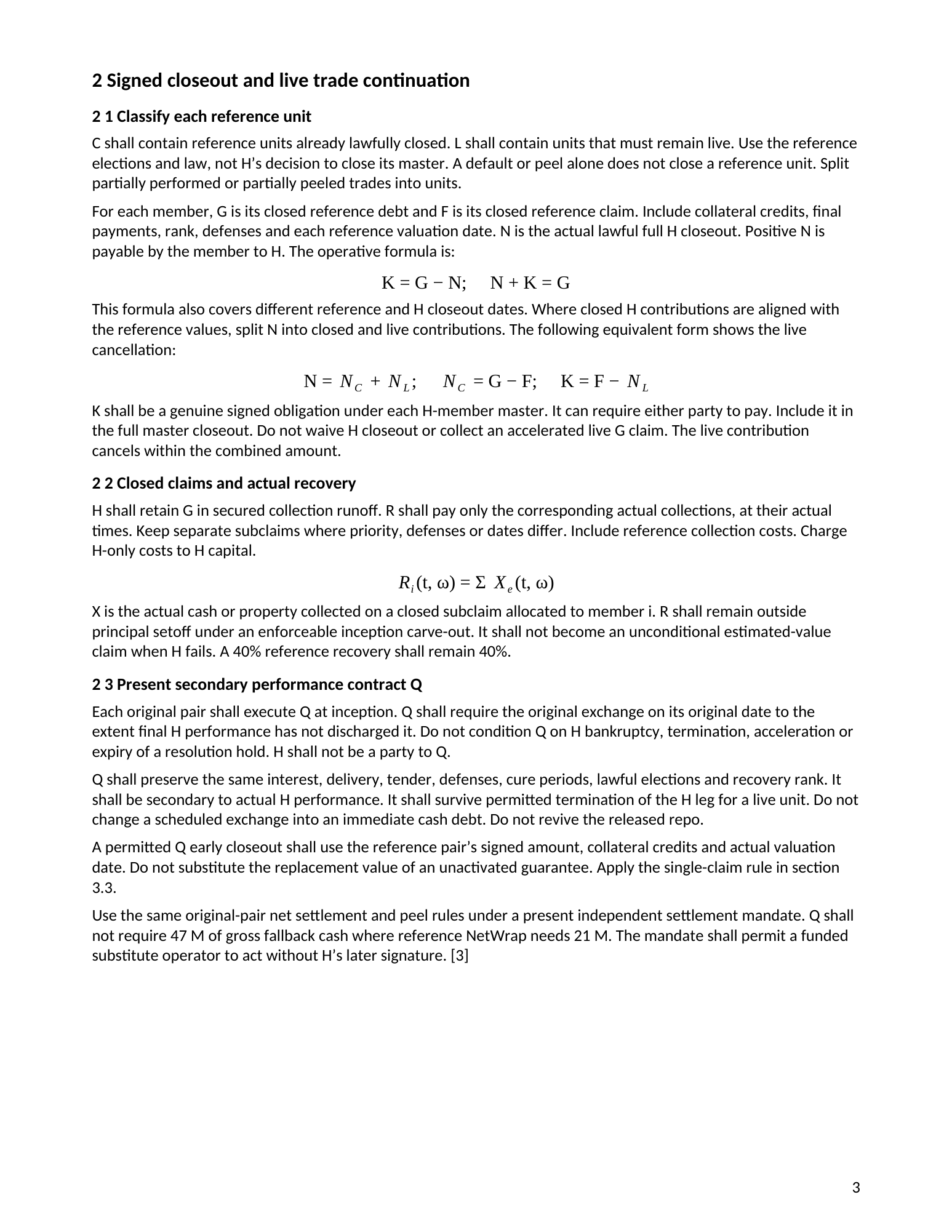
For each member, G is its closed reference debt and F is its closed reference claim. Include collateral credits, final payments, rank, defenses and each reference valuation date. N is the actual lawful full H closeout. Positive N is payable by the member to H. The operative formula is:
This formula also covers different reference and H closeout dates. Where closed H contributions are aligned with the reference values, split N into closed and live contributions. The following equivalent form shows the live cancellation:
K shall be a genuine signed obligation under each H-member master. It can require either party to pay. Include it in the full master closeout. Do not waive H closeout or collect an accelerated live G claim. The live contribution cancels within the combined amount.
2 2 Closed claims and actual recovery
H shall retain G in secured collection runoff. R shall pay only the corresponding actual collections, at their actual times. Keep separate subclaims where priority, defenses or dates differ. Include reference collection costs. Charge H-only costs to H capital.
X is the actual cash or property collected on a closed subclaim allocated to member i. R shall remain outside principal setoff under an enforceable inception carve-out. It shall not become an unconditional estimated-value claim when H fails. A 40% reference recovery shall remain 40%.
2 3 Present secondary performance contract Q
Each original pair shall execute Q at inception. Q shall require the original exchange on its original date to the extent final H performance has not discharged it. Do not condition Q on H bankruptcy, termination, acceleration or expiry of a resolution hold. H shall not be a party to Q.
Q shall preserve the same interest, delivery, tender, defenses, cure periods, lawful elections and recovery rank. It shall be secondary to actual H performance. It shall survive permitted termination of the H leg for a live unit. Do not change a scheduled exchange into an immediate cash debt. Do not revive the released repo.
A permitted Q early closeout shall use the reference pair’s signed amount, collateral credits and actual valuation date. Do not substitute the replacement value of an unactivated guarantee. Apply the single-claim rule in section 3.3.
Use the same original-pair net settlement and peel rules under a present independent settlement mandate. Q shall not require 47 M of gross fallback cash where reference NetWrap needs 21 M. The mandate shall permit a funded substitute operator to act without H’s later signature. [3]
3 Worked exits and joint defaults
3 1 H alone exits while all seven trades remain live
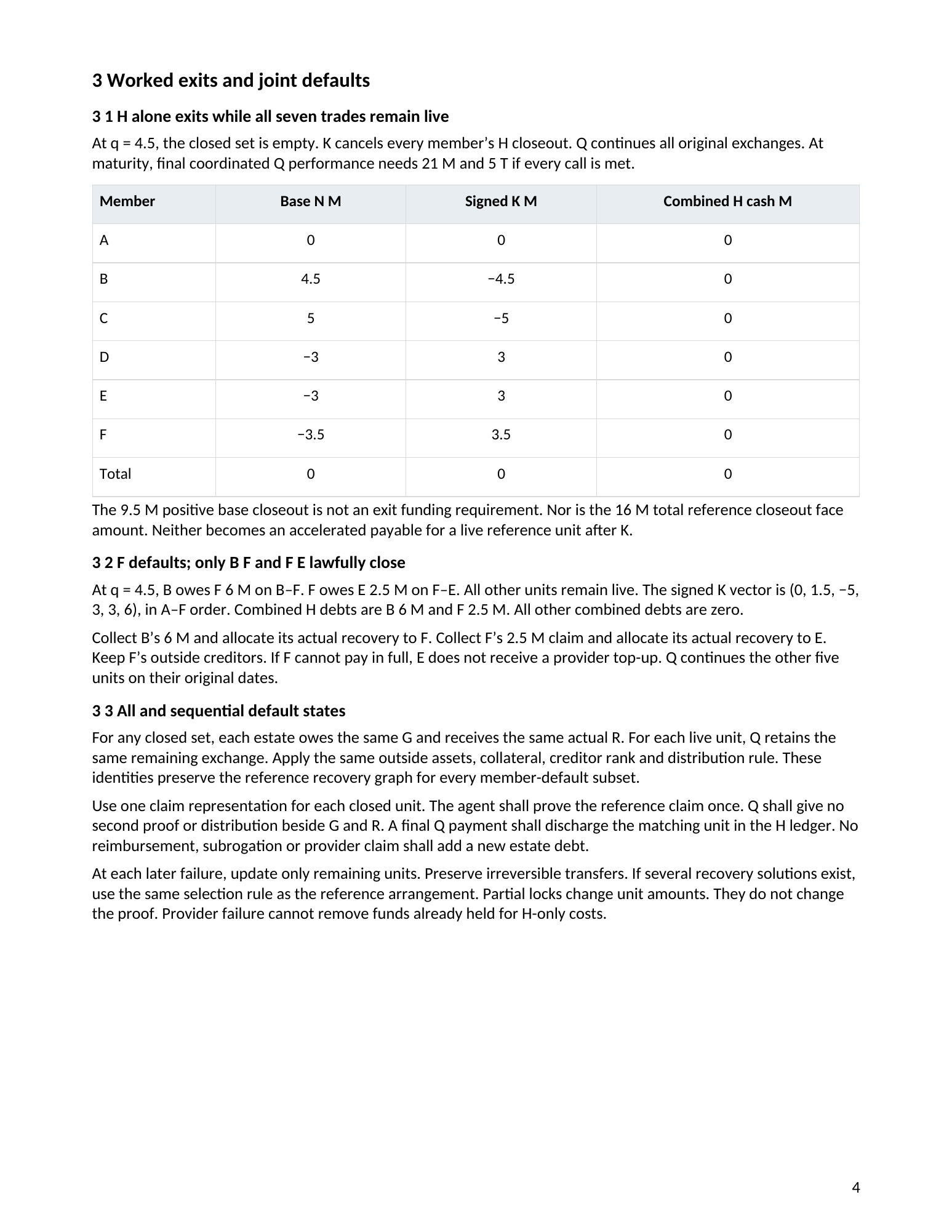
At q = 4.5, the closed set is empty. K cancels every member’s H closeout. Q continues all original exchanges. At maturity, final coordinated Q performance needs 21 M and 5 T if every call is met.
Member | Base N M | Signed K M | Combined H cash M |
|---|---|---|---|
A | 0 | 0 | 0 |
B | 4.5 | −4.5 | 0 |
C | 5 | −5 | 0 |
D | −3 | 3 | 0 |
E | −3 | 3 | 0 |
F | −3.5 | 3.5 | 0 |
Total | 0 | 0 | 0 |
The 9.5 M positive base closeout is not an exit funding requirement. Nor is the 16 M total reference closeout face amount. Neither becomes an accelerated payable for a live reference unit after K.
3 2 F defaults; only B F and F E lawfully close
At q = 4.5, B owes F 6 M on B–F. F owes E 2.5 M on F–E. All other units remain live. The signed K vector is (0, 1.5, −5, 3, 3, 6), in A–F order. Combined H debts are B 6 M and F 2.5 M. All other combined debts are zero.
Collect B’s 6 M and allocate its actual recovery to F. Collect F’s 2.5 M claim and allocate its actual recovery to E. Keep F’s outside creditors. If F cannot pay in full, E does not receive a provider top-up. Q continues the other five units on their original dates.
3 3 All and sequential default states
For any closed set, each estate owes the same G and receives the same actual R. For each live unit, Q retains the same remaining exchange. Apply the same outside assets, collateral, creditor rank and distribution rule. These identities preserve the reference recovery graph for every member-default subset.
Use one claim representation for each closed unit. The agent shall prove the reference claim once. Q shall give no second proof or distribution beside G and R. A final Q payment shall discharge the matching unit in the H ledger. No reimbursement, subrogation or provider claim shall add a new estate debt.
At each later failure, update only remaining units. Preserve irreversible transfers. If several recovery solutions exist, use the same selection rule as the reference arrangement. Partial locks change unit amounts. They do not change the proof. Provider failure cannot remove funds already held for H-only costs.
4 Property timing and legal continuity
4 1 Current property and collection rights
At first-leg completion, establish present contingent custody and security rights. Keep the reference title, reuse and return obligations at the original holders or custodians. Deliver first-leg property gross on H’s behalf where needed. Do not make Q depend on removal of property from H’s failed estate.
H shall own its financing claims before exit. Each H principal obligation shall expressly authorize beneficiary-directed Q performance. The security agent shall hold a perfected lien on identified live and closed collection rights, supporting collateral and proceeds. Secure the payment directions and matching R duties. A lien only on closed G claims is insufficient. Do not give members present beneficial ownership of H’s gross financing book. [4]
Use mutually exclusive enforcement branches for the same collateral. Preserve the original priority. Do not add security to an original unsecured deficiency. If the reference custodian loses Treasury, retain that same return claim and recovery. Fund only added H-caused loss from H resources.
An irrevocable mandate needs a substantive property interest or supporting consideration. The agency label alone does not supply it. [18]
4 2 H only resolution at the maturity deadline
A bank or Title II receiver can suspend otherwise-due H QFC payments until transfer notice or the statutory next-business-day deadline. An ordinary settlement mandate through H does not remove that suspension. Therefore an exit-triggered Q is insufficient. [5]
Q falls due for missing final performance on the original date. H resolution is not the trigger. Use member-owned cash and Treasury through the independent route. No H-owned cash or Treasury, new H signature or H closeout is required. Actual performance satisfies the identified H receivable under its inception payment terms.
Each final Q delivery shall legally satisfy both identified H legs at that same instant under their inception terms. It is authorized third-party performance, not a new reimbursement claim or later setoff. Defer only prohibited separate closeout or administrative acts. Carry the discharge record with any permitted all-or-none H package transfer. Never demand a second payment.
This legal credit cannot wait for H exit. Chapter 11 does not generally suspend H’s receivables from healthy members. If Q pays but the matching debt to H remains collectible, the structure creates double exposure. Later bookkeeping is permissible. Later legal satisfaction is not. [7]
A separate Q is not automatically H’s QFC. However, a court can extend protection to nondebtor obligations where enforcement immediately harms the debtor’s estate. The matched rights and discharge terms must address that risk. If Q requires a stayed H act, extra cash does not cure the defect. [19]
4 3 Reference member failure and rejection
Apply the reference member’s own mandatory hold to Q. Do not promise performance that the original pair could not lawfully require. Q rejection shall produce the same lawful reference breach, election and claim. H rejection cannot reject Q because H is not its party. [6]
Do not rely on a Q contract after its rights have lawfully ended. Record that event when it occurs. Use the same reference cure and closeout election. Retain the resulting claim in the single-claim ledger. Rejection is breach, not automatic rescission of granted rights. It does not compel future funding. [6]
5 Bankruptcy protection and estate value
5 1 Requirements shared with conventional clearing
Both methods need valid contracts, custody, settlement finality and netting. Qualified repo, securities-contract and swap remedies can use 11 USC 362(b), 559–561 and related provisions. Coverage follows the actual contract, participant and act. FDIC and Title II rules remain applicable. [5, 7]
A valid prepetition lock may be released or enforced through a protected contractual right after bankruptcy. Safe harbor does not validate every new lock or transfer. Test title, attachment, perfection, proceeds and avoidance separately. No protocol can contract away a mandatory legal prohibition. [4, 7]
5 2 NetWrap specific protections
K shall be an existing two-way financial obligation supported by consideration. Apply its formula to permitted voluntary exits and default exits. It shall not forgive a payment merely because H failed. The walkaway definitions exclude genuine netting of existing same-party obligations. That exclusion supports this design. A contract label alone does not. [5]
H shall never acquire a claim free of its inception K terms. An equal face-value cancellation added after failure is insufficient. For example, H may own a solvent B claim of 1 M and owe A and an outsider 1 M each. Later cancellation of the B and A legs can deprive the outsider of value. Record K’s consideration and netting rights at formation.
Keep each H-member base leg and K in the protected bilateral package. Do not permit a transfer of a positive leg without its offset and final-performance credits. R security shall attach before distress. Q shall impose direct member performance, not an exercise of a right against H’s estate. [4–5]
Use secured collection under NY UCC 9-607 and 9-608. Do not depend on post-default acceptance of collateral under 9-620. Keep complete-payment notices and obligor defenses. A later lawful transfer can end runoff, but zero purchase cash does not require that transfer. [8]
5 3 Scope of the all state result
The state proof covers arbitrary member defaults, lawful reference elections, H failure, joint failures and final partial performance. It assumes the stated inception rights are valid and remain available in the governing regime. It does not assume that an invalid lien or contract becomes valid because the payoff equation balances.
No finite cash reserve alone can restore a missing estate claim, priority or prohibited delivery. If law prevents the independent Q route in a covered regime, exact original timing is not established there. Correct that contract or exclude that regime from the implementation. Do not report a false all-state reserve.
5 4 CCP authorization
H shall be authorized for this actual principal-plus-K/R/Q architecture. Zero modeled reference exposure is not approval to omit required resources. The SEC distinguishes CCP interposition from ordinary agency services. The model is a design proposal. It does not establish compliance with a mandatory clearing requirement. [9]
6 Actual minimum resource calculation
6 1 Structural transaction reserve
Closed units need no cash purchase. R pays exactly the corresponding G collections. Live units need no closeout bridge. K cancels their H closeout contribution. Q uses the original members’ scheduled resources. No H advance is required in the exact model.
The modeled minimum is zero because the construction is feasible with zero reference prefunding and a nonnegative reserve cannot be lower. This result covers price changes and joint defaults through the signed formulas. It is not obtained by assuming that an uncollected K assessment is usable cash.
The ordinary member lock is 21 M and 5 T. Across all active subsets, peak calls are 25 M and 7 T. Those are member settlement deliveries, not H capital. A provider shall not fund an original member’s failed call permanently. That would change the benchmark.
6 2 Common operating cost assumption and separate capital floor
Use zero ordinary operating expense for NetWrap and FICC. E is annual expense. W is the funded need for recovery or orderly wind-down administration. W remains unmeasured and outside both transaction comparisons. It does not fund repo principal or original credit losses. [10]1
The equation gives the explicit business-capital floor. Actual business capital B must also cover assessed general business risk under Rule 17ad-22(e)(15). Exclude B from the common transaction comparison. J covers residual H credit, liquidity, custody and implementation risks. Count shared resources once. Business capital remains additional to default and liquidity resources. [10]
Take the supremum over required states and times, using cumulative due payments and receipts. Prepayment peeling can reduce L only before an unconditional H obligation falls due. The exact atomic model gives L = 0. The website provides no banking or custody data to price departures from that model.
6 3 Default fund and margin deposits
The exact package gives zero reference credit loss to H. Its model reference initial margin and mutualized default fund are therefore zero. H still needs risk-based margin and default resources for remaining exposures under Rule 17ad-22(e)(4), (6) and (7). No general six-member 6 M floor applies to a new H. [10]
New member collateral that improves a reference creditor’s recovery violates the benchmark. Use separately funded H resources for H-only risks. Do not impose new default-contingent fees, reimbursement claims or loss allocations on members. Fees and their funding effects need a common comparison baseline.
The calculated structural transaction reserve is zero. Actual operating and implementation resources remain separate: B + J. The common zero operating-expense assumption does not set W or J to zero. The participant tables exclude corporate operating capital in both methods.
6 4 Numerical verification
The prior model checks 10,935 aligned-date cases and 10,935 different-date cases. These cover all 2,187 absent, live or closed partitions at five prices. Another 40,960 recovery tests retain outside creditors and 64 stress patterns. The revision also checks the proposed fund formula and all table ratios. These tests check arithmetic and modeled state identities. They do not establish legal enforceability.
7 FICC prospective rules and resource calculation
7 1 Published design and approval status
Use SR-FICC-2026-008 as amended for the prospective comparison. FICC published the actual draft in Exhibit 5. It separates initial margin from a cash Guaranty Fund. Initial margin shall not absorb other members’ mutualized losses. The proposal seeks bankruptcy-remote treatment for those margin deposits. [20]
The SEC action deadline is 9 November 2026. The SEC may approve, disapprove or start further proceedings by that date. A related advance notice has a separate 21 November 2026 review deadline. Neither date is an implementation commitment. [20]
FICC targets implementation no later than 1 March 2027, subject to all approvals. It will announce the effective date by Important Notice. The SEC record reviewed on 25 October 2026 did not show approval. Proposed future rule legends do not themselves establish approval. [20]
7 2 Margin and Guaranty Fund have separate functions
Required Fund Deposits remain calculated initial margin. FICC would initially set the minimum margin charge to zero. The risk calculation and applicable extra charges remain. Thus a zero floor does not establish zero initial margin. [20]
The separate Guaranty Fund shall hold cash. It covers the stress deficiencies of the two affiliated member families that create the largest aggregate exposure. This is the Cover 2 requirement. Deduct each defaulting family’s own usable margin. Do not use healthy members’ margin as a mutualized default pool. [20]
Let L_i,s be member i’s loss in scenario s. Let I_i be its usable initial margin. Aggregate affiliated members before the Cover 2 selection. The simplified equations below omit FICC buffers and other usable defaulting-member resources.
D_1,s and D_2,s are the two largest affiliated-family deficiencies in the same scenario. Take the maximum over all required scenarios. Let C_max be the largest Cover 2 requirement in the lookback. Let a_i be member i’s average largest daily deficiency in that lookback.
FICC initially intends a 1 M minimum Guaranty Fund contribution per member. Its rule permits a minimum between 0.1 M and 5 M. The risk-based contribution itself has no 5 M cap. The initial lookback is 12 months. [20]
The sum of member floors can make G_total exceed both 6 M and C_2. Therefore max(6 M, C_2) is not the correct aggregate formula. FICC may also apply buffers, resizing and a Stress Test Deficiency Charge. [20]
7 3 Membership basis and missing inputs
The main illustration counts six standalone direct dealer memberships. Each selected member contributes at least 1 M across its business. This floor gives 6 M before any higher risk-based contribution. It is not a per-trade or per-group fee.
For existing members, calculate the change in their full requirements before and after the new book. The member minimum may already be funded. Do not attribute it again to this group.
Incremental resources equal the new whole-member requirement minus the old whole-member requirement.
The website supplies trade amounts, not the daily returns, full portfolios or 12-month deficiency history. It does not supply collateral eligibility, add-ons or whole-system fund allocation inputs. Therefore actual FICC initial margin and incremental fund contributions are unmeasured.
Let I be total calculated initial margin in M. Let Γ be the selected six members’ total Guaranty Fund amount above their 6 M floor. The main table uses these variables. It does not assume that their actual values are zero.
Let A_F be FICC’s selected funded resources. Let C_F be annual opportunity cost. Both amounts are in M.
7 4 Explicit illustrative stress facsimile
This sensitivity is a closed six-member model. It is not a production FICC calculation. Use a 1% price-move proxy for initial margin. This is an assumed amount, not a measured 99% VaR estimate. Omit add-ons, corporate resources and liquidation costs.
Set opening price q to 4.5 and assume that its full mark was paid. Use the inherited stress price of 2. This is a 55.6% price fall. It is an extreme toy price path, not a calibrated Treasury scenario.
Let t_i be member i’s signed net Treasury quantity.
Firm | Net Treasury T absolute | Assumed margin M | Stress deficiency M | Toy fund contribution M |
|---|---|---|---|---|
A | 2 | 0.090 | 0 | 1 |
B | 3 | 0.135 | 0 | 1 |
C | 0 | 0 | 0 | 1 |
D | 0 | 0 | 0 | 1 |
E | 2 | 0.090 | 4.910 | 4.910 |
F | 3 | 0.135 | 7.365 | 7.365 |
Total | 10 | 0.450 | 12.275 | 16.275 |
Repeat this one downward snapshot to form the toy lookback shares. E has share 0.4 and F has share 0.6. The other four shares are zero. Their four minimum contributions add 4 M to the 12.275 M Cover 2 requirement.
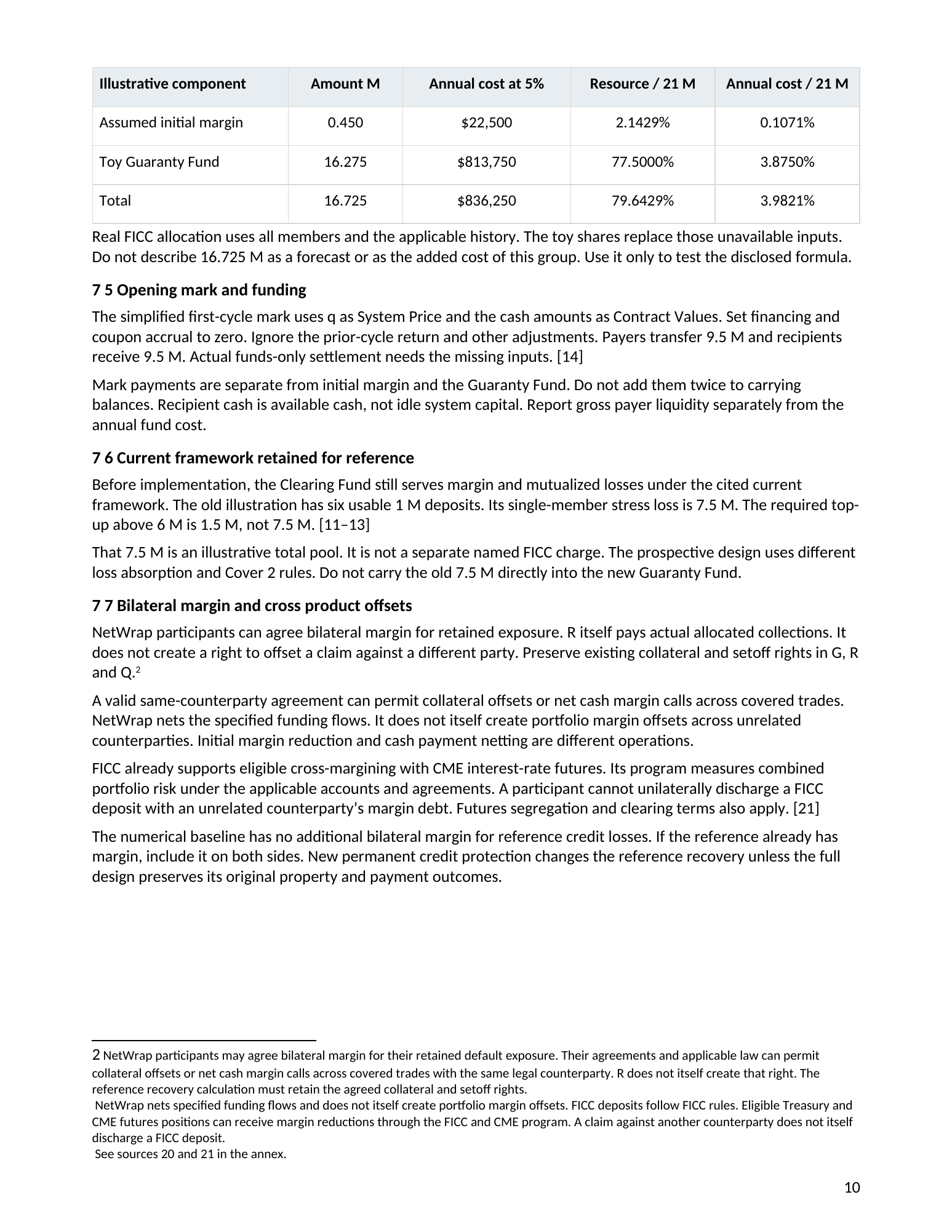
Illustrative component | Amount M | Annual cost at 5% | Resource / 21 M | Annual cost / 21 M |
|---|---|---|---|---|
Assumed initial margin | 0.450 | $22,500 | 2.1429% | 0.1071% |
Toy Guaranty Fund | 16.275 | $813,750 | 77.5000% | 3.8750% |
Total | 16.725 | $836,250 | 79.6429% | 3.9821% |
Real FICC allocation uses all members and the applicable history. The toy shares replace those unavailable inputs. Do not describe 16.725 M as a forecast or as the added cost of this group. Use it only to test the disclosed formula.
7 5 Opening mark and funding
The simplified first-cycle mark uses q as System Price and the cash amounts as Contract Values. Set financing and coupon accrual to zero. Ignore the prior-cycle return and other adjustments. Payers transfer 9.5 M and recipients receive 9.5 M. Actual funds-only settlement needs the missing inputs. [14]
Mark payments are separate from initial margin and the Guaranty Fund. Do not add them twice to carrying balances. Recipient cash is available cash, not idle system capital. Report gross payer liquidity separately from the annual fund cost.
7 6 Current framework retained for reference
Before implementation, the Clearing Fund still serves margin and mutualized losses under the cited current framework. The old illustration has six usable 1 M deposits. Its single-member stress loss is 7.5 M. The required top-up above 6 M is 1.5 M, not 7.5 M. [11–13]
That 7.5 M is an illustrative total pool. It is not a separate named FICC charge. The prospective design uses different loss absorption and Cover 2 rules. Do not carry the old 7.5 M directly into the new Guaranty Fund.
7 7 Bilateral margin and cross product offsets
NetWrap participants can agree bilateral margin for retained exposure. R itself pays actual allocated collections. It does not create a right to offset a claim against a different party. Preserve existing collateral and setoff rights in G, R and Q.2
A valid same-counterparty agreement can permit collateral offsets or net cash margin calls across covered trades. NetWrap nets the specified funding flows. It does not itself create portfolio margin offsets across unrelated counterparties. Initial margin reduction and cash payment netting are different operations.
FICC already supports eligible cross-margining with CME interest-rate futures. Its program measures combined portfolio risk under the applicable accounts and agreements. A participant cannot unilaterally discharge a FICC deposit with an unrelated counterparty’s margin debt. Futures segregation and clearing terms also apply. [21]
The numerical baseline has no additional bilateral margin for reference credit losses. If the reference already has margin, include it on both sides. New permanent credit protection changes the reference recovery unless the full design preserves its original property and payment outcomes.
8 Accounting and cost comparison
8 1 Legal release and secondary performance
ASC 405-20-40-2 permits release from primary debt when a third party assumes it and the old debtor becomes secondarily liable. Recognize the new guarantee. FAS 140 paragraph 114 supplies the public source lineage. Thus secondary Q does not automatically retain the old gross debt. A mere relabeling of primary bilateral debt fails this test. [15]
Draft Q as a contingent reciprocal Treasury/cash performance contract. Tie it to identified financial performance and Treasury value. Advance no new principal into Q. Use readily convertible Treasury or permitted cash settlement.
This supports ASC 815. The funded host’s initial investment is not automatically the embedded derivative’s investment. Test ASC 815-15 and linked units. [16]
The financial-guarantee exception requires specified conditions, including payment only after the underlying obligation is past due. Q requires reciprocal performance at the reference time, including H payment suspension. It is broader than reimbursement of overdue H debt. Do not rely solely on the technical meaning of past due during a stay. ASU 2025-07 retains financial-asset and financial-liability performance underlyings. Check adoption. [16]
If Q is a performance or financial guarantee outside ASC 815, apply ASC 460 and applicable credit-loss or contingency guidance. Recognize the stand-ready obligation at inception. Do not infer an equal separate asset for the beneficiary. A guarantee of H performance differs from a promise of the guarantor’s own primary performance. [15]
Keep the ordinary funded H financing recognized and apply eligible repo offsets. Derivative, guarantee and host-allocation amounts can change carrying balances. Legal setoff alone does not determine accounting units or permit repo-to-derivative presentation offsets. Assess ASC 810 consolidation of H and its capital provider.
8 2 Participant balance bridge
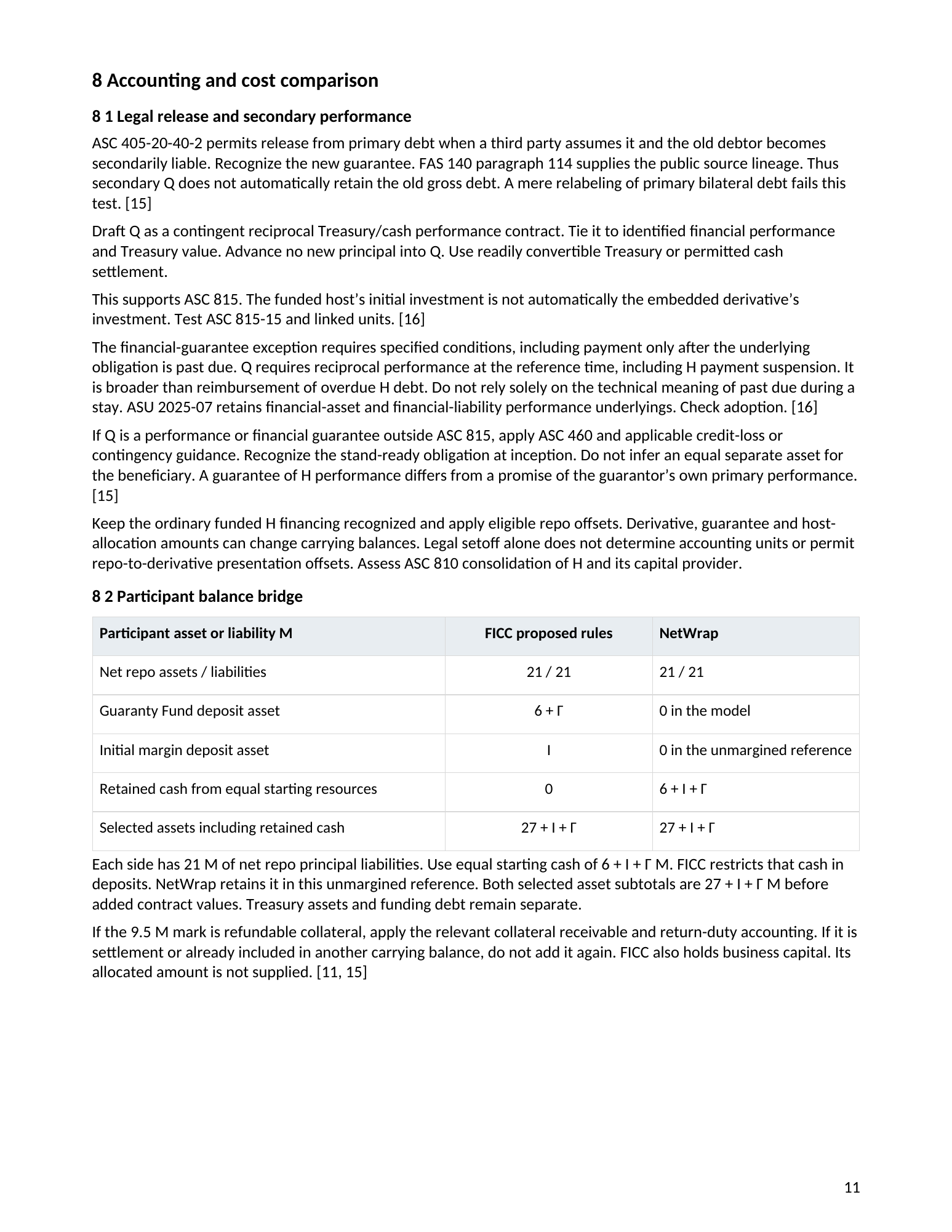
Participant asset or liability M | FICC proposed rules | NetWrap |
|---|---|---|
Net repo assets / liabilities | 21 / 21 | 21 / 21 |
Guaranty Fund deposit asset | 6 + Γ | 0 in the model |
Initial margin deposit asset | I | 0 in the unmargined reference |
Retained cash from equal starting resources | 0 | 6 + I + Γ |
Selected assets including retained cash | 27 + I + Γ | 27 + I + Γ |
Each side has 21 M of net repo principal liabilities. Use equal starting cash of 6 + I + Γ M. FICC restricts that cash in deposits. NetWrap retains it in this unmargined reference. Both selected asset subtotals are 27 + I + Γ M before added contract values. Treasury assets and funding debt remain separate.
If the 9.5 M mark is refundable collateral, apply the relevant collateral receivable and return-duty accounting. If it is settlement or already included in another carrying balance, do not add it again. FICC also holds business capital. Its allocated amount is not supplied. [11, 15]
8 3 Five percent net lost profit
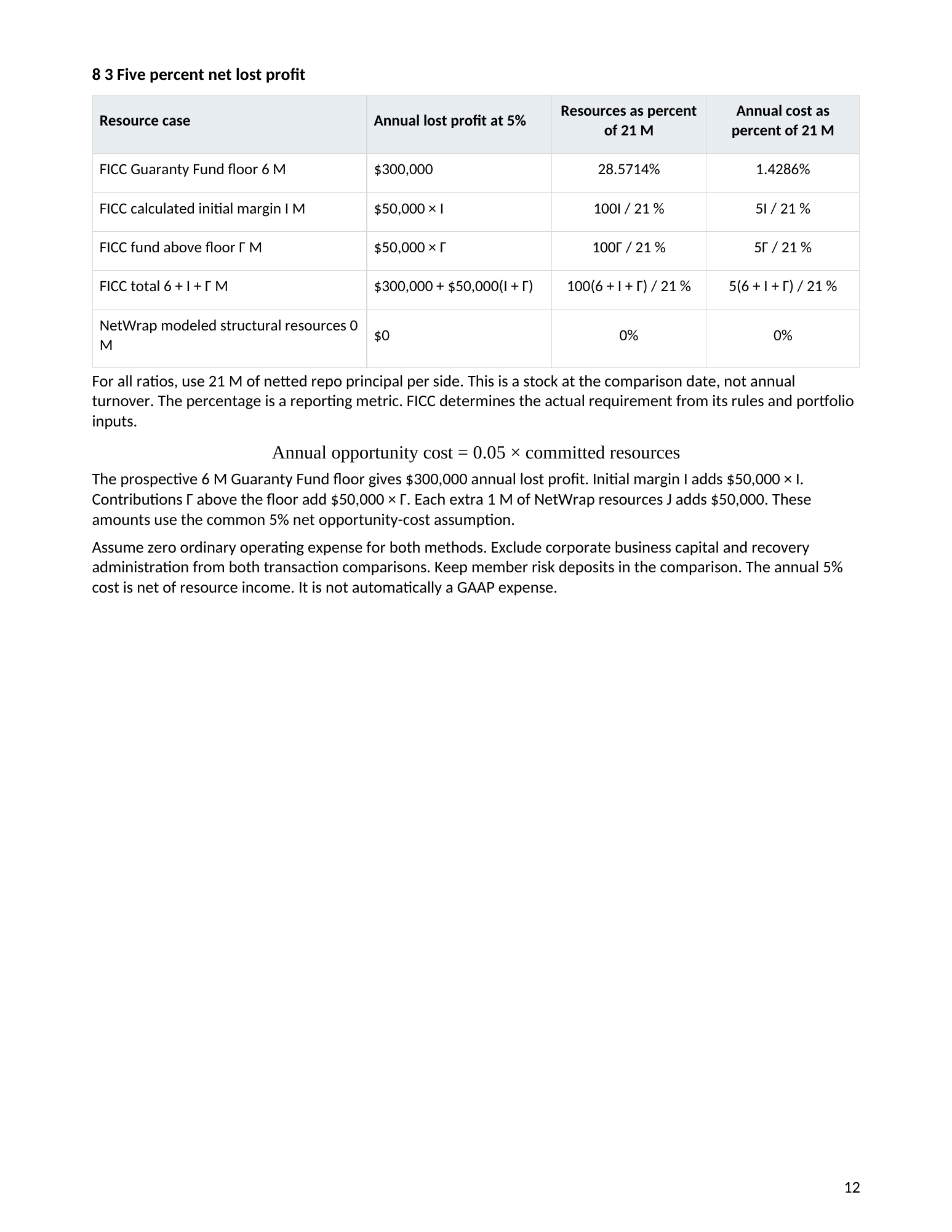
Resource case | Annual lost profit at 5% | Resources as percent of 21 M | Annual cost as percent of 21 M |
|---|---|---|---|
FICC Guaranty Fund floor 6 M | $300,000 | 28.5714% | 1.4286% |
FICC calculated initial margin I M | $50,000 × I | 100I / 21 % | 5I / 21 % |
FICC fund above floor Γ M | $50,000 × Γ | 100Γ / 21 % | 5Γ / 21 % |
FICC total 6 + I + Γ M | $300,000 + $50,000(I + Γ) | 100(6 + I + Γ) / 21 % | 5(6 + I + Γ) / 21 % |
NetWrap modeled structural resources 0 M | $0 | 0% | 0% |
For all ratios, use 21 M of netted repo principal per side. This is a stock at the comparison date, not annual turnover. The percentage is a reporting metric. FICC determines the actual requirement from its rules and portfolio inputs.
The prospective 6 M Guaranty Fund floor gives $300,000 annual lost profit. Initial margin I adds $50,000 × I. Contributions Γ above the floor add $50,000 × Γ. Each extra 1 M of NetWrap resources J adds $50,000. These amounts use the common 5% net opportunity-cost assumption.
Assume zero ordinary operating expense for both methods. Exclude corporate business capital and recovery administration from both transaction comparisons. Keep member risk deposits in the comparison. The annual 5% cost is net of resource income. It is not automatically a GAAP expense.
9 Added values and sources
9 1 Added values are not zero
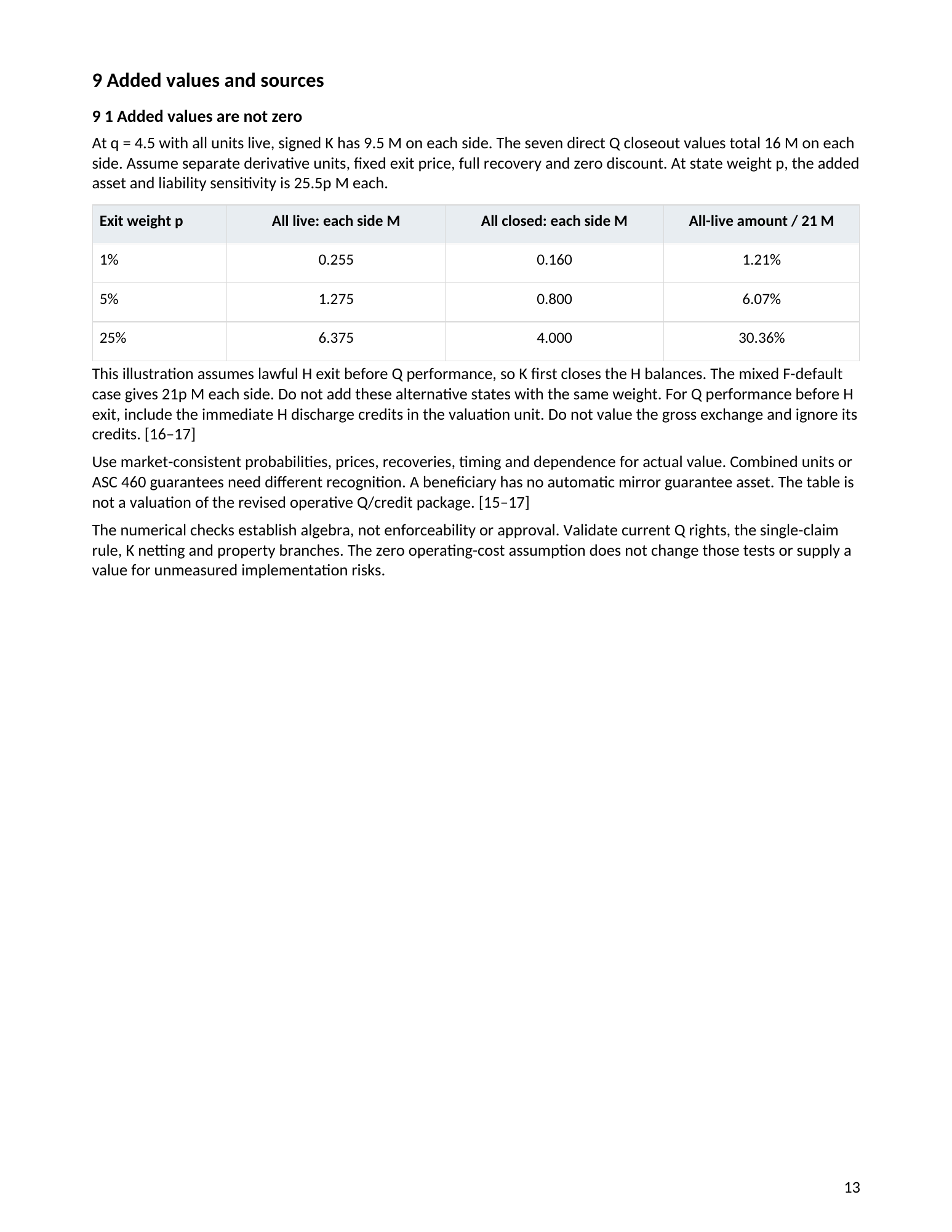
At q = 4.5 with all units live, signed K has 9.5 M on each side. The seven direct Q closeout values total 16 M on each side. Assume separate derivative units, fixed exit price, full recovery and zero discount. At state weight p, the added asset and liability sensitivity is 25.5p M each.
Exit weight p | All live: each side M | All closed: each side M | All-live amount / 21 M |
|---|---|---|---|
1% | 0.255 | 0.160 | 1.21% |
5% | 1.275 | 0.800 | 6.07% |
25% | 6.375 | 4.000 | 30.36% |
This illustration assumes lawful H exit before Q performance, so K first closes the H balances. The mixed F-default case gives 21p M each side. Do not add these alternative states with the same weight. For Q performance before H exit, include the immediate H discharge credits in the valuation unit. Do not value the gross exchange and ignore its credits. [16–17]
Use market-consistent probabilities, prices, recoveries, timing and dependence for actual value. Combined units or ASC 460 guarantees need different recognition. A beneficiary has no automatic mirror guarantee asset. The table is not a valuation of the revised operative Q/credit package. [15–17]
The numerical checks establish algebra, not enforceability or approval. Validate current Q rights, the single-claim rule, K netting and property branches. The zero operating-cost assumption does not change those tests or supply a value for unmeasured implementation risks.
10 Sources
[1] NetWrap central clearing overview; seven-trade example. Source
[2] ASC 210-20-45-11; FIN 41 paragraphs 3–4 and FIN 39. Source 1 · Source 2 · Source 3
[3] 12 USC 4404; protected multilateral netting, subject to eligibility. Source
[4] NY UCC 9-203 and 9-315; 11 USC 552. Current security and proceeds. Source 1 · Source 2 · Source 3
[5] 12 USC 1821(e)(8)–(10), 5390(c)(8)–(10): stays, walkaway and transfer rules. Source 1 · Source 2
[6] 11 USC 365 and 562; Mission Product v Tempnology, 587 US 370 (2019). Source 1 · Source 2 · Source 3
[7] 11 USC 362, 546 and 559–561. Source 1 · Source 2 · Source 3 · Source 4 · Source 5
[8] NY UCC 9-406, 9-607, 9-608, 9-602 and 9-620. Source 1 · Source 2 · Source 3 · Source 4 · Source 5
[9] SEC Release 34-88616, pp. 10–11; Treasury clearing release, p. 2725. Source 1 · Source 2
[10] 17 CFR 240.17ad-22(e)(4), (6), (7), (15). Source
[11] FICC GSD Rulebook, 26 August 2026; Rule 1, Rule 4 and Margin Component Schedule. Source
[12] DTCC Clearing Fund Methodology, version 2.1, November 2025. Source 1 · Source 2
[13] Proposed fund changes, SEC Release 34-106054; CCLF guide. Source 1 · Source 2
[14] DTCC DVP Funds-Only Settlement. Source
[15] ASC 405-20-40-2, ASC 460 and ASC 860; FAS 140 paragraphs 15–16, 114; FIN 45. Source 1 · Source 2
[16] ASC 815; FAS 133 paragraphs 6–9, 12, 16; FAS 149 paragraphs 4, 5, 7(c); F6/K1; ASU 2025-07. Source 1 · Source 2 · Source 3 · Source 4
[17] ASC 820; ASU 2011-04. Public legacy texts provide lineage; current ASC controls. Source
[18] Frankel v J.P. Morgan Chase, 76 AD3d 664, 668 (2010). Agency interest. Source
[19] Bank of New York Mellon v DeMatteis, 222 AD3d 1 (2023). Nondebtor stay limits. Source
[20] FICC proposal SR-FICC-2026-008 as amended. Exhibit 5 Rule 4A. Initial parameters in filing footnotes 32 and 33. Approval and implementation remain separate. Source 1 · Source 2 · Source 3 · Source 4 · Source 5
[21] FICC and CME cross-margining. CFTC customer fund protections. Same-party setoff requirements. Source 1 · Source 2 · Source 3
Exposure identity and amount
Counterparty exposure identity. Identity means the original pair to which an unpaid obligation or default loss belongs. NetWrap retains that pair and its specified reference recovery rights. A direct settlement route does not itself replace the party bearing the loss.
Counterparty exposure amount. Amount requires a stated measure. For settlement, it is the cash or securities that each participant must lock for the active group. For credit loss, it is the unrecovered reference claim after closeout, collateral and estate recoveries. These are different amounts. The website phrase “original counterparty exposure preserved and reduced” refers to identity retained and settlement funding netted down.
Net funding and the shortfall bound. For participant i and object k in a fixed active group, let G be gross outgoing obligations and A be incoming obligations. The net lock requirement is R = max(G - A, 0), so 0 <= R <= G. With usable funding F >= 0, the lock shortfall is max(R - F, 0) <= max(G - F, 0). Netting therefore weakly reduces the maximum shortfall on that round’s funding call. A participant without offsetting inflows may have no reduction. Cash and securities remain separate objects.
Recalculation after a failure. A peel changes the active group and can raise a survivor’s call relative to the previous net call. Apply the bound to that new group. Peeled obligations remain separately enforceable; their removal is not an additional saving or a reduction in the reference creditor’s loss.
Value at risk. Statistical value at risk (VaR) is a loss quantile for a stated horizon and probability model. A lower funding requirement alone does not establish lower default-loss VaR. If each participant has the same loss in every reference state, with the same state probabilities, its default-loss VaR is unchanged. Reduced liquidity pressure can affect default probabilities or funding costs in a broader model, but those effects require calibration. No strict VaR reduction for every participant is established here.
Amounts in the clearing example. Normal second-leg settlement uses 21 M and 5 T instead of 47 M and 14 T gross, reductions of 55.3% and 64.3%, respectively. Across active subsets, the separate maxima are 25 M and 7 T. These are settlement requirements, not measures of default credit loss.
Default fund and margin deposits. The exact principal-CCP contract package leaves H with zero reference credit loss and no unmatched settlement advance. It therefore needs zero default-fund and CCP margin deposits for those modeled risks. This removes mutualization of reference losses; the original pairs retain them. Settlement locks, agreed bilateral margin, collateral securing original repos and resources J for added risks remain separate. Applicable CCP rules and regulatory resource requirements remain binding unless validly changed.
Relation to the SEC systemic risk objective. The SEC identifies lower settlement-failure exposure as a benefit of multilateral netting. NetWrap’s smaller funding calls can contribute to that objective without mutualizing reference losses. This is an inference about the settlement-liquidity channel, not a proof of lower total system risk or compliance with the central-clearing mandate. Existing guarantees, margin and operational safeguards require their own assessment.
Source: SEC Release 34-99149 (13 December 2023), pp. 15–16 and 288–289. Treasury clearing final rule
Footnotes
Default assumption: Annual ordinary operating expense is zero for NetWrap and the comparison service. Corporate business capital and recovery or wind-down overhead are outside both transaction comparisons. Those exclusions do not establish zero actual regulatory capital.
↩NetWrap participants may agree bilateral margin for their retained default exposure. Their agreements and applicable law can permit collateral offsets or net cash margin calls across covered trades with the same legal counterparty. R does not itself create that right. The reference recovery calculation must retain the agreed collateral and setoff rights.
NetWrap nets specified funding flows and does not itself create portfolio margin offsets. FICC deposits follow FICC rules. Eligible Treasury and CME futures positions can receive margin reductions through the FICC and CME program. A claim against another counterparty does not itself discharge a FICC deposit.
See sources 20 and 21 in the annex.
↩